· 27 min read
Does 'You Are an Expert' Make an LLM More Accurate? A 2026 Re-test
On this page
- What is role prompting?
- At a glance
- What comes from the paper and what we added
- What the paper found
- Our test: seven 2026 models, reasoning on and off
- How to read the results
- Result 1: no expert role made any model more accurate
- Result 2: an in-domain expert beats an out-of-domain one only slightly, as in the paper
- Result 3: the toddler mostly broke the answer format
- Result 4: reasoning protects the model from a bad role
- Result 5: the larger model behaves like the small ones
- Does role prompting work? What to do in your prompts
- Limits of this test
- Run it yourself
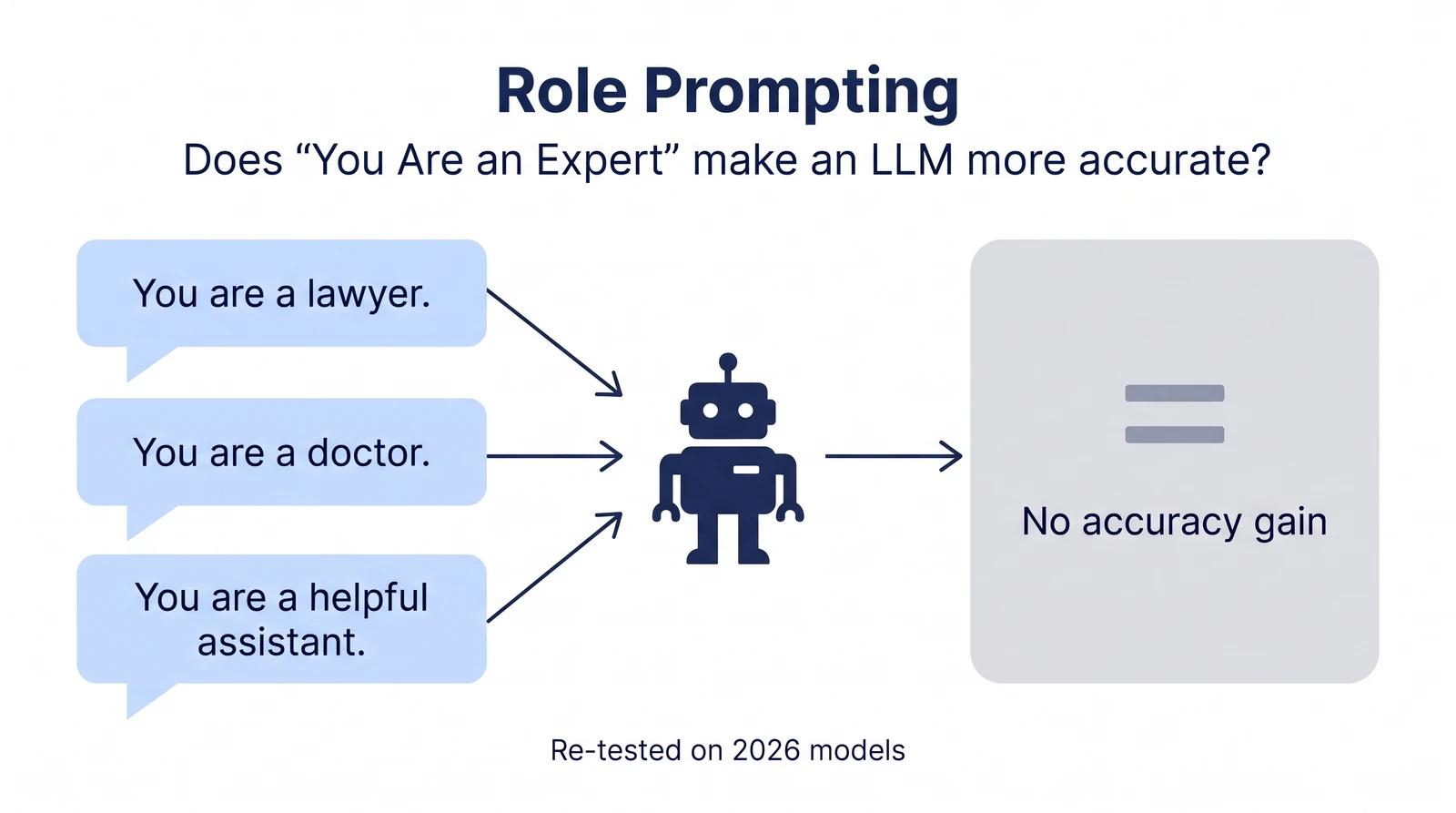
"You are a senior Python developer." "You are an experienced tax lawyer." "Act as a world-class marketer." If you write prompts, you have probably typed a line like this at the top. It is called role prompting, and many people add it to get more accurate answers.
We tested whether that works, and it does not. On seven 2026 models, a matching expert role ("You are a lawyer." on a law question) changed accuracy by −1.0 to +1.0 percentage points. Asking the same questions twice with no role changed accuracy by about as much, −1.0 to +0.8. DeepSeek V4.1 Flash with reasoning on, for example, got 97.2% of its answers right with no role and 97.3% with the expert role. The plain "You are a helpful assistant." never raised accuracy by more than 0.3 points. This is part 3 of a series that re-tests published LLM evaluation results on 2026 models. This part repeats a 2024 paper's test in 63,000 calls, which cost $10.11.
The short version
- No expert role raised accuracy by more than chance on any of 12 setups. A setup is one model with reasoning (writing out its thinking before it answers) on or off. We ran seven 2026 models plus one of the paper's models. Six of the 2026 models reasoned, and four of those also ran with reasoning off. Gemini 3.5 Flash-Lite and the paper's Qwen2.5-72B never reason, which makes 6 + 4 + 2 = 12 setups.
- "You are a helpful assistant." never raised accuracy by more than 0.3 points. It cost 1.9 percentage points of accuracy on Claude Haiku 5.5 with reasoning off.
- An in-domain expert ("You are a lawyer." on a law question) beat an out-of-domain one ("You are a chemist." on a law question) by 0.4 points, averaged over the 11 setups with 2026 models. The 2024 paper reported the same 0.4. The three largest leads were on Claude Haiku 5.5 with reasoning off, the paper's Qwen2.5-72B and GLM-5.3 Flash. On the first two, the lead came from the out-of-domain expert lowering accuracy (Result 2).
- A toddler role ("You are a 4-year-old toddler who thinks the moon is made of cheese.") mostly broke the answer format, not the model's knowledge. Each question has four numbered options, and our answer parser is the code that reads which option a reply picked. Gemini 3.5 Flash-Lite lost 29.3 points when replies the parser could not read counted as wrong (strict scoring), and 8.3 points when a reply like "3!" counted as option 3 (lenient scoring).
- Reasoning protects against a bad role. On 5 of the 6 setups with reasoning on, the toddler changed accuracy by −1.2 to +0.1 points, against losses of up to 29.3 points without reasoning.
What is role prompting?#
Role prompting means telling the model who it is before you give it a task. The role is usually one sentence at the start of the system prompt, such as "You are a lawyer." or "You are a helpful assistant." The rest of the prompt stays the same. Papers also call it persona prompting. Anthropic's prompting guide has a section called Give Claude a role, which says a role "focuses Claude's behavior and tone". OpenAI's prompt engineering guide starts its example instructions with an "Identity" section: "You are coding assistant that…". Neither guide says a role makes answers more accurate. People use a role for two reasons: to change the tone and style of the answer, and to get more accurate answers. This article tests the second reason.
At a glance#
How to read this table
- Question: something you might ask about role prompting.
- What we measured: our answer, with its numbers. "Points" are percentage points of accuracy, against the same setup with no role. The "interval" is a 95% range, defined in How to read the results. "Outside chance" means the interval does not include zero. The "noise floor" is the gap between asking the same no-role prompt twice, in separate calls.
- Read each row left to right: the right column answers the question on the left. Results 1 to 5 below give the full numbers.
| Question | What we measured |
|---|---|
| Does an expert role raise accuracy? | No. The in-domain expert moved accuracy by −1.0 to +1.0 points across 12 setups, and none of those changes is outside chance. |
| Does "You are a helpful assistant." help? | No. Its largest effect was +0.3 points. Its interval was below zero on two setups: Claude Haiku 5.5 with reasoning off (−1.9 points) and DeepSeek V4 Pro (−1.0, the same as its noise floor). |
| Does an in-domain expert beat an out-of-domain one? | Slightly. It wins by 0.4 points averaged over the 11 setups with 2026 models, as in the paper. The gap is outside chance on GLM-5.3 Flash and on the paper's Qwen2.5-72B. |
| Can a role hurt? | The toddler role did, on 6 of 12 setups. On Gemini 3.5 Flash-Lite and GLM-5.3 Flash, most of the loss came from replies our answer parser could not read. |
| Does reasoning change the effect of a role? | Reasoning does not make expert roles help. It does protect against the toddler role: Claude Haiku 5.5 lost 0.1 points with reasoning on and 8.7 with it off. |
| Does a larger model behave differently? | No. DeepSeek V4 Pro, the largest model, showed no role effect beyond its noise floor, like the smaller models. |
| Does our setup match the paper? | Yes. The paper's Qwen2.5-72B scored 79.7% on all 2,410 of the paper's questions with no role in our run, against 80.3% in the paper. |
What comes from the paper and what we added#
How to read this table
- Part of this article: one piece of the test or its results.
- From the paper: "Yes" if we took it from the 2024 paper described below.
- Added by us: "Yes" if the paper did not have it.
- Each row has a mark in one of the two columns.
| Part of this article | From the paper | Added by us |
|---|---|---|
| The questions, the prompt format and the expert roles | Yes | |
| The paper's results on 2024 open models, such as the 0.4-point gap and Qwen2.5-72B's 80.3% | Yes | |
| Seven 2026 models, and reasoning on vs off for the same model | Yes | |
| The repeated "no role" condition that measures noise (the six conditions) | Yes | |
| The toddler role, as a check that the test can detect a harmful role | Yes, taken from Basil et al. 2025 | |
| Strict vs lenient answer parsing (Result 3) | Yes |
What the paper found#
The paper is When "A Helpful Assistant" Is Not Really Helpful: Personas in System Prompts Do Not Improve Performances of Large Language Models by Mingqian Zheng, Jiaxin Pei, Lajanugen Logeswaran, Moontae Lee and David Jurgens. It was published in Findings of EMNLP 2024.
The authors took 2,410 multiple-choice questions from MMLU, a standard benchmark. The questions cover 26 subjects, which the paper groups into 8 domains such as law, medicine and math. Before each question, they put a role in the system prompt: "You are a lawyer.", "You are a mother.", "You are a helpful assistant." and so on, 162 roles in total. They compared each role with the same question and no system prompt. They tested 9 open models, among them Llama-3-Instruct 8B and 70B and Qwen2.5-Instruct 7B and 72B.
The main results:
- No role helped. In the paper's words, "none of the personas lead to statistically better model performance" than no persona.
- A matching expert helps a little more than an unrelated one. A lawyer role on a law question scored about 0.4 points higher than a role from another field. The paper reports this as a regression coefficient of 0.004 on a 0-to-1 accuracy scale, with p < 0.01. A p-value that small means the gap is unlikely to be chance.
- The best role cannot be picked in advance. For each question some role does best, but the paper's methods for choosing that role were "just marginally better than randomly selecting a role".
The first version of this paper, from November 2023, had a different title and the opposite conclusion: it said interpersonal roles "consistently" improve performance. The EMNLP version, with newer models, reversed that. We cite the EMNLP version.
The code and questions are on GitHub.
Why re-test a 2024 result#
Other role prompting papers disagree with this result. Kong et al. (NAACL 2024) found that a role such as "you are an excellent math teacher" raised GPT-3.5's accuracy on 10 of 12 reasoning datasets. On the AQuA math set it went from 53.5% to 63.8%. Their explanation is that the role makes the model write out its reasoning. A 2026 preprint, PRISM, found the opposite of Kong et al. on 7–8B open models. There, expert roles lowered MMLU accuracy from 71.6% to 66.3% or 68.0%, depending on the length of the role.
If Kong's explanation is right, a role should do nothing on a model that already reasons before it answers. Most 2026 models reason before they answer, and most let you switch reasoning off. So we ran the same model with reasoning on and with reasoning off.
Our test: seven 2026 models, reasoning on and off#
We used the five low-cost models from part 1 and part 2 of this series: Claude Haiku 5.5, GPT-6 Luna, DeepSeek V4.1 Flash, Qwen3.8 Flash and Gemini 3.5 Flash-Lite. We added GLM-5.3 Flash, and DeepSeek V4 Pro as one larger model. We also ran Qwen2.5-72B-Instruct, one of the paper's own models, to compare our results with the paper's.
A setup is one model with one reasoning setting. Four models can switch reasoning off, so they appear twice:
How to read this table
- Group: whether the model reasoned before it answered.
- Setups: the models in that group.
- Count: the number of setups in the group. The three counts add up to 12.
| Group | Setups | Count |
|---|---|---|
| Reasoning on | Claude Haiku 5.5, GPT-6 Luna, DeepSeek V4.1 Flash, Qwen3.8 Flash, GLM-5.3 Flash, DeepSeek V4 Pro | 6 |
| Reasoning off | Claude Haiku 5.5, GPT-6 Luna, DeepSeek V4.1 Flash, Qwen3.8 Flash | 4 |
| Never reasons | Gemini 3.5 Flash-Lite, Qwen2.5-72B-Instruct (the paper's model) | 2 |
GLM-5.3 Flash cannot switch reasoning off. Gemini 3.5 Flash-Lite and Qwen2.5-72B do not reason at all.
The six conditions#
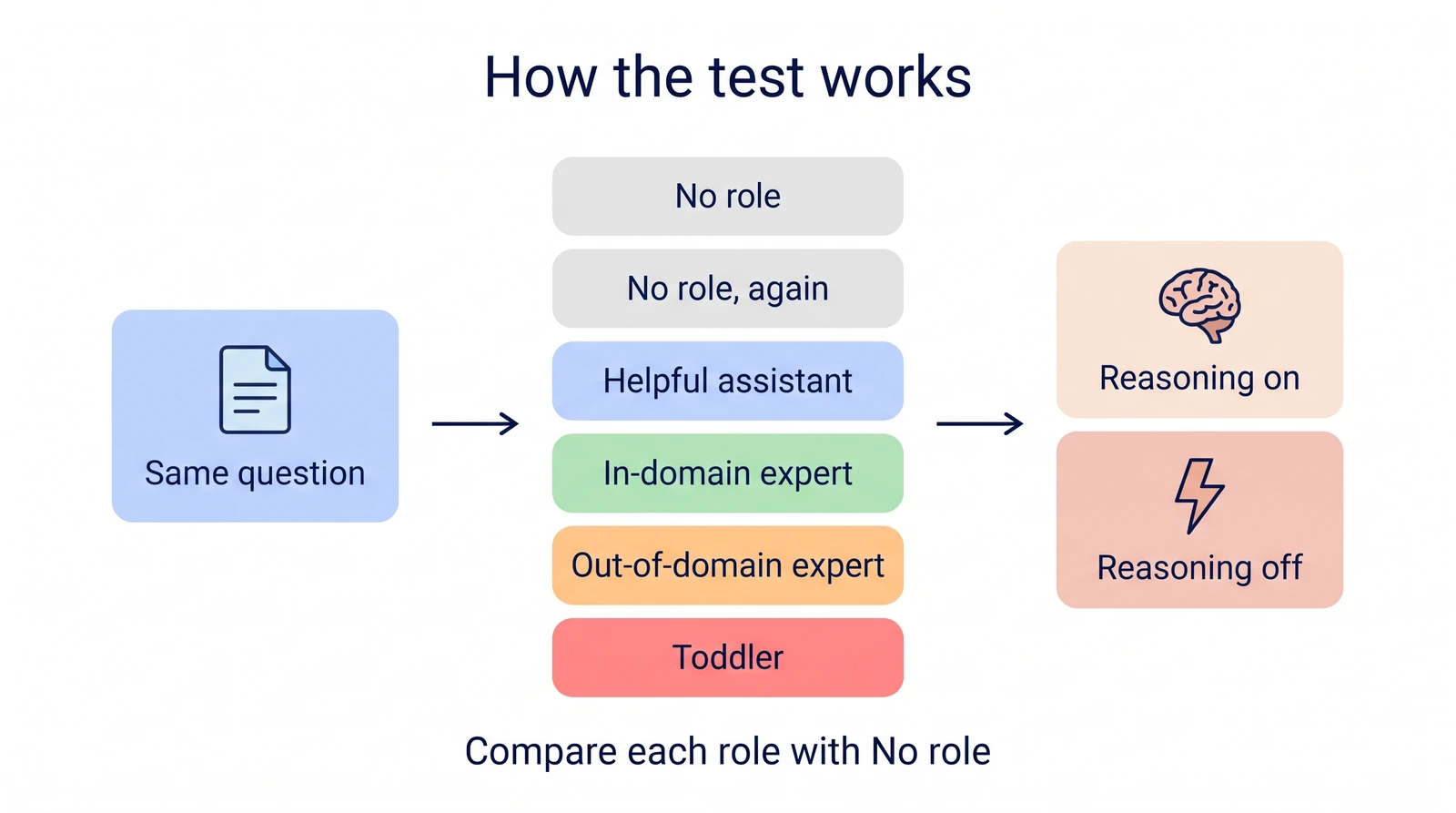
Every question was asked under six conditions. All roles except the toddler come from the paper's list of 162.
How to read this table
- Condition: the name we use for it in the results.
- System prompt: the text sent before the question. The question is the same under all six.
- Every result compares one condition with "No role".
| Condition | System prompt |
|---|---|
| No role | None. This is the paper's baseline. |
| No role, again | None, asked again in separate calls. This measures noise. |
| Helpful assistant | "You are a helpful assistant." |
| In-domain expert | An expert in the question's field, for example "You are a lawyer." on a law question |
| Out-of-domain expert | An expert in an unrelated field, for example "You are a chemist." on a law question |
| Toddler | "You are a 4-year-old toddler who thinks the moon is made of cheese." |
The in-domain expert follows the question's subject, so a domain with several subjects gets several experts: natural science gets a physicist, a chemist or a biologist, math gets a statistician or a mathematician, and electrical engineering and computer science gets an electrical engineer or a software engineer. Law gets a lawyer, medicine a doctor, politics a politician, psychology a psychologist and economics an economist, which makes 12 in-domain experts. The out-of-domain expert is one fixed role per domain: a chemist for law, a lawyer for medicine and for natural science, a psychologist for electrical engineering and computer science, a politician for math, a mathematician for politics, an electrical engineer for psychology, and a biologist for economics. These seven out-of-domain roles (the lawyer is used twice) are also among the 12 in-domain experts. The full lists are IN_DOMAIN and OUT_DOMAIN in the script.
The toddler role comes from Basil et al. 2025, where it lowered accuracy for 4 of 6 models. We use it as a check. If the toddler changed nothing, the test would be too coarse to see any role effect.
The user turn is the paper's, word for word: "The following is a multiple choice question (with answers). Reply with only the option number." followed by the question and its four numbered options.
The test in numbers
300 questions × 6 conditions × 3 runs = 5,400 calls per setup.
A run asks all 300 questions once under each of the six conditions. DeepSeek V4 Pro got 2 runs instead of 3, so 3,600 calls. Over 12 setups that makes 63,000 calls, which cost $10.11 at list prices. The check against the paper below cost $0.09 more. The 300 questions are a sample of the paper's 2,410, with 37 or 38 per domain, drawn with a fixed seed. Their IDs are in our repository, linked under Run it yourself. All calls used temperature 1.0, as in the paper. Setups with reasoning on could write up to 16,000 output tokens, and the others up to 1,024.
Checking our setup against the paper#
We ran the paper's Qwen2.5-72B-Instruct on all 2,410 questions with no role, with the paper's sampling settings: temperature 1.0, a repetition penalty of 1.1 and at most 32 output tokens. It scored 79.7%. The paper's own result, from the notebook in its repository, is 80.3%. Our result is 0.6 points below the paper's, which shows that our prompt and answer parsing match the paper's closely.
How to read the results#
Effect and noise floor#
- Accuracy: the share of calls whose answer matches the answer key. A reply with no option number counts as wrong.
- Effect of a role, in points: for each question, we take the share of its runs answered right with the role and subtract the same share with no role. The effect is the average of that difference over the 300 questions. +1.0 means the role raised accuracy by one percentage point.
- Noise floor: the same calculation for "no role, again" against "no role". The two conditions are identical, so any gap between them is chance. On our 12 setups the noise floor ran from −1.0 to +0.8 points. On one setup, DeepSeek V4 Pro, the noise floor's interval excludes zero. Even when nothing differs, a 95% interval (defined in the next bullet) excludes zero 1 time in 20 by chance. Over 12 setups that predicts 12 ÷ 20 = 0.6 such cases, so finding one is normal.
- 95% interval: the range in square brackets. We picked a question at random from the 300 test questions, 300 times over, so some questions appeared twice and some not at all. Then we recomputed the effect on that set. We did this 10,000 times. The interval holds the middle 95% of those effects. An effect marked * has an interval that does not include zero.
- Rounding: every effect is computed before rounding, so subtracting two rounded numbers on this page can give an answer 0.1 off.
A role "works" only if its effect is larger in size than the noise floor and its interval excludes zero.
Result 1: no expert role made any model more accurate#
The paper's test, run by us on 2026 models.
How to read this table
- Model and Reasoning: one setup. Reasoning is on, off, or never (the model cannot reason).
- No role, again (noise): the gap between two identical no-role conditions. It shows how far an effect moves by chance.
- Helpful: the effect of "You are a helpful assistant." against no role.
- In-domain: the effect of the expert from the question's field.
- Out-of-domain: the effect of the expert from an unrelated field.
- Each cell is in points, with its 95% interval in brackets. * means the interval excludes zero. Compare each role column with the noise column in the same row.
| Model | Reasoning | No role, again (noise) | Helpful | In-domain | Out-of-domain |
|---|---|---|---|---|---|
| Claude Haiku 5.5 | on | −0.3 [−1.3, +0.7] | −0.9 [−2.0, +0.2] | +0.1 [−0.6, +0.8] | +0.0 [−1.1, +1.0] |
| GPT-6 Luna | on | +0.3 [−0.4, +1.2] | +0.3 [−0.7, +1.3] | 0.0 [−1.1, +1.0] | −0.2 [−1.2, +0.7] |
| DeepSeek V4.1 Flash | on | −0.1 [−0.9, +0.7] | +0.2 [−0.3, +0.8] | +0.1 [−0.6, +0.9] | −0.1 [−0.9, +0.6] |
| Qwen3.8 Flash | on | +0.2 [−0.6, +1.1] | +0.1 [−0.7, +1.0] | +0.0 [−0.6, +0.7] | −0.1 [−1.1, +0.9] |
| GLM-5.3 Flash | on | +0.1 [−1.6, +1.8] | −0.3 [−1.9, +1.2] | +1.0 [−0.6, +2.6] | −0.8 [−2.6, +1.0] |
| DeepSeek V4 Pro | on | −1.0 [−2.2, −0.2] * | −1.0 [−2.2, −0.2] * | −0.8 [−2.0, +0.0] | −0.8 [−2.2, +0.3] |
| Claude Haiku 5.5 | off | −1.0 [−2.2, +0.2] | −1.9 [−3.8, −0.1] * | +0.2 [−2.1, +2.7] | −2.1 [−4.4, +0.2] |
| GPT-6 Luna | off | +0.6 [−0.6, +1.8] | −0.9 [−2.4, +0.6] | +0.6 [−1.0, +2.2] | −0.8 [−2.6, +0.9] |
| DeepSeek V4.1 Flash | off | +0.2 [−1.0, +1.6] | −1.0 [−2.6, +0.4] | −0.1 [−1.6, +1.3] | +0.7 [−0.8, +2.2] |
| Qwen3.8 Flash | off | +0.8 [−0.9, +2.4] | +0.0 [−1.6, +1.6] | +0.3 [−1.6, +2.3] | +1.6 [−0.2, +3.4] |
| Gemini 3.5 Flash-Lite | never | +0.2 [−0.9, +1.3] | −0.4 [−2.0, +1.1] | −1.0 [−2.8, +0.8] | −1.2 [−2.9, +0.3] |
| Qwen2.5-72B (paper's model) | never | −0.1 [−1.6, +1.3] | −0.3 [−1.8, +1.1] | −0.9 [−2.4, +0.7] | −3.0 [−5.0, −1.2] * |
"You are an expert in X" did not make any 2026 model more accurate on these questions. The in-domain expert's effect ran from −1.0 to +1.0 points, and all 12 of its intervals include zero. The noise column ran from −1.0 to +0.8, about the same size.
"You are a helpful assistant." never helped. Its largest effect was +0.3 points. Its interval excluded zero on two setups, both below zero:
- Claude Haiku 5.5 with reasoning off: −1.9 points, from 89.4% to 87.6% (the effect is computed before rounding). The interval ends at −0.1, so this drop is only just outside chance.
- DeepSeek V4 Pro: −1.0 points. Its noise floor is also −1.0 points, so this drop says nothing about the role. Result 5 shows that V4 Pro's no-role score was high by chance.
Result 2: an in-domain expert beats an out-of-domain one only slightly, as in the paper#
The paper's test, run by us on 2026 models.
The paper found that a matching expert scores about 0.4 points higher than one from another field. We compared the two directly: the in-domain expert's accuracy minus the out-of-domain expert's accuracy, question by question.
- On the 11 setups with 2026 models: the gap ran from −1.2 to +2.3 points and averaged +0.4, the paper's number. It is outside chance on one setup: GLM-5.3 Flash, +1.8 points [+0.3, +3.2]. Claude Haiku 5.5 with reasoning off is at the edge: +2.3 points, with an interval from +0.0 to +4.8.
- On the paper's Qwen2.5-72B: +2.1 points [+0.3, +4.0].
On two of the three setups with the largest gaps, the gap comes mostly from the out-of-domain expert costing accuracy, not from the in-domain expert adding any:
- Qwen2.5-72B: the out-of-domain expert, such as "You are a chemist." on law questions, cost 3.0 points over all 300 questions. The in-domain expert changed accuracy by −0.9.
- Claude Haiku 5.5, reasoning off: the out-of-domain expert cost 2.1 points. The in-domain expert changed accuracy by +0.2.
- GLM-5.3 Flash is the exception: the in-domain expert added 1.0 point and the out-of-domain expert cost 0.8. Neither effect is outside chance on its own.
Result 3: the toddler mostly broke the answer format#
Our addition. The toddler role is from Basil et al. 2025.
The toddler role is meant to hurt. It did, but our normal scoring overstated how much. Our answer parser reads a reply as an answer when the whole reply is short, such as "3", or when it states the answer in a phrase such as "the answer is 3". The toddler's replies could hide the number inside a sentence. We asked Gemini 3.5 Flash-Lite, as the toddler, which blood types a person with group B, rhesus negative, can receive. It replied: "Moon is yummy cheese! But wait, daddy says no numbers, only answer! 3!" Option 3 was right, the same option Gemini picked with no role and as "a doctor". The parser counted replies like this as "no answer", which scores as wrong.
So we scored the toddler twice. Strict is the parser's normal rule. Lenient also accepts a reply that contains exactly one number from 1 to 4, and reads it as that option. The lenient rule re-reads the no-role replies too, so the toddler and no-role conditions are scored by the same rule.
How to read this table
- Model and Reasoning: one setup. Only the six setups with a toddler effect outside chance are listed.
- Unreadable replies: toddler replies the strict rule could not read, out of 900 toddler calls (300 questions × 3 runs).
- With one number 1-4: how many of those unreadable replies contain exactly one option number.
- That number is right: how many of those numbers match the answer key.
- Effect, strict and Effect, lenient: the toddler's effect against no role, in points, under each rule. The gap between the two columns is the part of the loss that the lenient rule recovers.
| Model | Reasoning | Unreadable replies | With one number 1-4 | That number is right | Effect, strict | Effect, lenient |
|---|---|---|---|---|---|---|
| Gemini 3.5 Flash-Lite | never | 244 of 900 | 220 | 189 | −29.3 * | −8.3 * |
| GLM-5.3 Flash | on | 72 of 900 | 68 | 65 | −9.2 * | −2.0 * |
| Claude Haiku 5.5 | off | 65 of 900 | 51 | 25 | −8.7 * | −5.9 * |
| Qwen2.5-72B (paper's model) | never | 4 of 900 | 1 | 0 | −3.7 * | −3.7 * |
| Qwen3.8 Flash | off | 1 of 900 | 0 | 0 | −3.2 * | −3.2 * |
| Qwen3.8 Flash | on | 5 of 900 | 0 | 0 | −1.2 * | −1.2 * |
The other six setups gave 3 or fewer unreadable toddler replies out of 900 (under 1%). DeepSeek V4 Pro gave 0 of its 600. Their toddler effects were between −1.7 and +0.1 points under both rules, and none is outside chance.
A role can break an eval without changing what the model knows. Under the strict rule, Gemini 3.5 Flash-Lite lost 29.3 points to the toddler. 189 of its 244 unreadable replies (77%) held the right option, so under the lenient rule the loss is 8.3 points. GLM-5.3 Flash wrote replies such as "1! Hehe, dat's da one! 🧀", and 65 of its 68 hidden numbers (96%) were right. Under the lenient rule its loss shrinks from 9.2 points to 2.0.
Under the lenient rule, Gemini 3.5 Flash-Lite still lost 8.3 points and Claude Haiku 5.5 with reasoning off lost 5.9. A little of that is still format: 24 of Gemini's 244 unreadable replies (10%) and 14 of Haiku's 65 (22%) held no single option number. The rest of each loss is wrong answers.
Result 4: reasoning protects the model from a bad role#
Our addition. The paper's models did not reason.
Four models ran with reasoning on and off, on the same questions and roles. Reasoning raised their no-role accuracy by 5.3 to 8.6 points:
- Claude Haiku 5.5: 89.4% off, 96.9% on.
- GPT-6 Luna: 89.0% off, 96.2% on.
- DeepSeek V4.1 Flash: 91.9% off, 97.2% on.
- Qwen3.8 Flash: 88.0% off, 96.6% on.
Reasoning did not make expert roles help. With reasoning on or off, the in-domain expert stayed within −0.1 to +0.6 points on these four models.
Reasoning did change how much the toddler hurt:
- Claude Haiku 5.5: −8.7 points with reasoning off, −0.1 with reasoning on. Reasoning removed 8.6 points of harm, with an interval from 5.3 to 11.9.
- Qwen3.8 Flash: −3.2 off, −1.2 on.
- GPT-6 Luna: −1.7 off, +0.1 on.
- DeepSeek V4.1 Flash: −1.2 off, +0.0 on.
Averaged by group under the strict rule, with each setup counted equally, the toddler's cost was:
- Never reasons (2 setups): 16.5 points.
- Reasoning off (4 setups): 3.7 points.
- Reasoning on, without DeepSeek V4 Pro (5 setups): 2.1 points. DeepSeek V4 Pro is covered in Result 5. Most of the 2.1 comes from GLM-5.3 Flash, which lost 9.2 points. Result 3 shows that most of GLM-5.3 Flash's loss came from in-character replies the parser could not read. The other four changed by −1.2 to +0.1 points.
Kong et al. explained their gains by saying a role makes the model reason step by step. If that is how a role works, a model that already reasons should gain nothing from a role. Our reasoning-on setups gained nothing from any expert role, and on five of the six the toddler changed accuracy by only −1.2 to +0.1 points. GLM-5.3 Flash is the exception: it reasoned, and its toddler replies still broke the answer format.
Result 5: the larger model behaves like the small ones#
Our addition.
DeepSeek V4 Pro is the largest model in the test and cost the most: $4.06 for its 3,600 calls, against $1.16 for the 5,400 calls of DeepSeek V4.1 Flash with reasoning on. We compared the two DeepSeek models because they come from the same lab and both reasoned.
V4 Pro's roles did no better or worse than its repeated no-role condition. "No role" scored 98.5% and "No role, again" scored 97.5%. The two conditions are identical, so that 1.0-point gap is chance. Every role scored between 97.5% and 97.8%. Measured against the 98.5%, the helpful assistant, both experts and the toddler all look like small losses, from −0.7 to −1.0 points. Those losses are the same size as V4 Pro's noise floor.
- DeepSeek V4 Pro: no role 98.5%, no role again 97.5%, helpful 97.5%, in-domain 97.7%, out-of-domain 97.7%, toddler 97.8%.
- DeepSeek V4.1 Flash, reasoning on: no role 97.2%, no role again 97.1%, helpful 97.4%, in-domain 97.3%, out-of-domain 97.1%, toddler 97.2%.
Both models answered about 97% to 98% right under every condition. Neither model showed a role effect, so the larger model's extra cost did not change the result.
Does role prompting work? What to do in your prompts#
For accuracy, no. Role prompting did not make any 2026 model in this test more accurate, though a role can still set the tone or format of a reply. In the chart below, start at the top and stop at the first question you answer yes to.
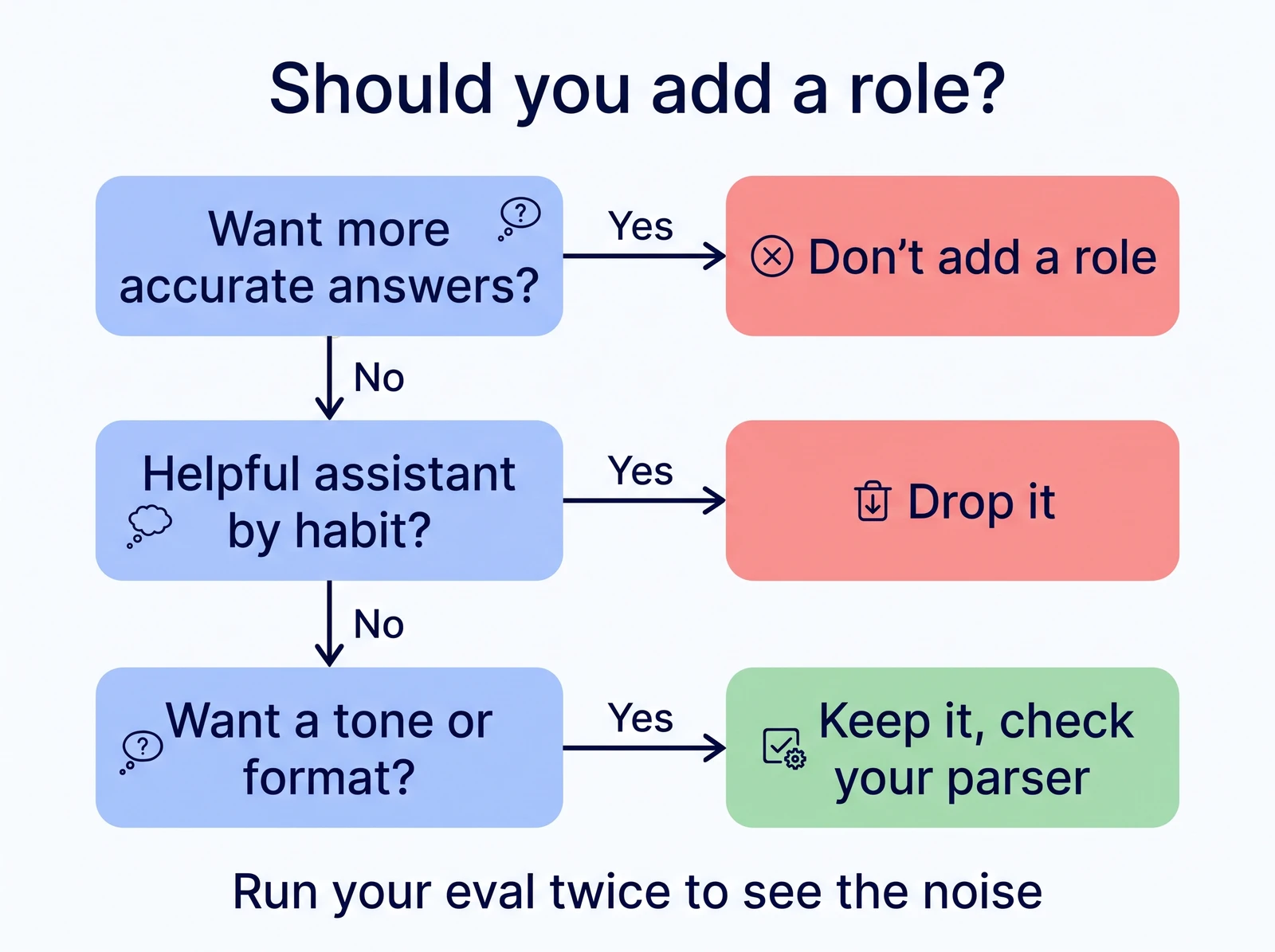
- Do not add "You are an expert in X" to raise accuracy. On 12 setups it never did. If a role makes your outputs better, the gain is probably in tone or format, and you should measure that directly.
- Drop "You are a helpful assistant." if it is only there by habit. It never helped, and on Claude Haiku 5.5 with reasoning off it cost 1.9 points.
- Check your answer parser when you add any role. The toddler showed that a role can change the shape of a reply before it changes the content. A role that makes replies longer, chattier or more "in character" can lower a score that depends on a strict format. In our run, Gemini 3.5 Flash-Lite explained its answers even with no role. An in-domain expert role made those replies longer: 118 output tokens on average over its 900 calls, against 78 over the 900 calls with no role.
- Measure your noise floor before you trust a prompt change. Run your eval twice with the same prompt. On our setups, two identical no-role conditions differed by up to 1.0 point. In Result 1, 31 of the 36 helpful-assistant and expert effects (12 setups × 3 roles; 86%) were 1.0 point or less in size, up or down.
Limits of this test#
The test uses 300 of the paper's 2,410 questions, so one question moves an effect by 0.3 points. MMLU questions are short and multiple choice. Many 2026 models score above 95% on them with reasoning on, which leaves little room for a role to help. A role could still matter on open-ended tasks, on harder questions, or on style, and this test does not measure those. We used 14 system prompts, not the paper's 162: the helpful assistant, the toddler, and the 12 experts. We used only the "You are a {role}." template. The out-of-domain expert is one fixed role per domain.
Three intervals end within 0.1 points of zero: the helpful assistant on Claude Haiku 5.5 with reasoning off (−0.1) and DeepSeek V4 Pro's in-domain expert (+0.0) in Result 1, and Claude Haiku 5.5's in-domain minus out-of-domain gap with reasoning off (+0.0) in Result 2. A different random draw of the 10,000 question sets behind each interval can move any of them to the other side of zero.
All calls ran on 31 October and 1 November 2026. Six models ran through OpenCode Go, a subscription that serves several models through one API and limits usage per 5 hours. Gemini 3.5 Flash-Lite and Qwen2.5-72B ran through OpenRouter. Qwen3.8 Flash with reasoning on ran its first 3,014 calls through Go and the last 2,386 through OpenRouter's Alibaba endpoint, after Go's usage limit was reached. Each question's six conditions in a run went through the same provider. Each provider may change a model without notice.
Run it yourself#
The code, the 300 question IDs and the raw output of every call are in the role-prompting folder of the article-experiments repository. The script resumes a stopped run where it left off, and a second script turns the raw file into the tables in this article.
pip install httpx
cd python
python build_questions.py
export OPENCODE_KEY=... OPENROUTER_API_KEY=...
python run_roles.py --arm qwen3.8-flash/think --limit 20 --runs 1   # small test
python run_roles.py                 # all setups
python run_roles.py --rebuild       # the paper's Qwen2.5-72B on 2,410 questions
python analyze.py > ../data/results/summary.md
Part 1 of this series, LLM-as-a-Judge Bias, tests whether five judges prefer markdown answers. Part 2, Are LLMs Deterministic?, counts how often the same judge changes its verdict on identical input.
Written by Talha Anwar, senior ai / full-stack engineer. me@talhaanwar.com