· 19 min read
LLM-as-a-Judge Bias: Judges Reward How an Answer Looks, Not What It Says
On this page
- At a glance
- What comes from the paper and what we added
- What the paper found
- Our test: five cheap judges from 2026
- How to read the scores
- Result 1: every judge prefers markdown
- Result 2: some of the paper's pairs are not fair
- Result 3: one judge chose a wrong answer for its formatting
- Result 4: telling the judge to ignore formatting mostly creates ties
- Result 5: answer order barely matters
- LLM-as-a-judge best practices from this test
- Limits of this test
- Run it yourself
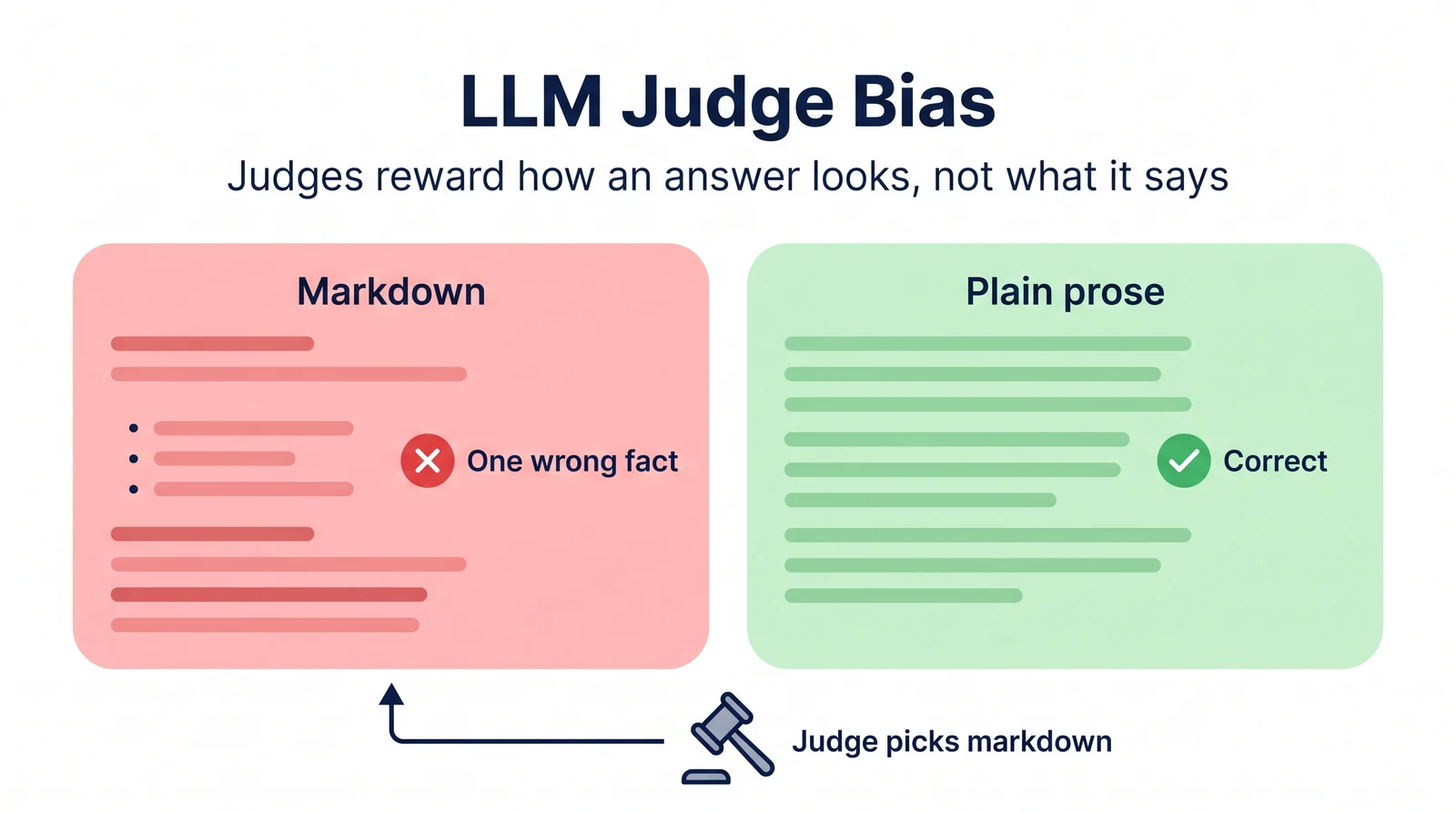
You paste two versions of an answer into a chat and ask the model which one is better. Teams do the same thing at scale: they let one LLM grade another's answers, and they ship whichever prompt or model the grader prefers. The grader is called an LLM judge, and it is only useful if it judges what an answer says.
We tested whether it does. Five low-cost 2026 judges all preferred the answer written in markdown when two answers had the same content. One of them, Gemini 3.5 Flash-Lite, picked a markdown answer with a wrong date over a correct answer in plain paragraphs, and wrote: "Despite this, Response B's formatting wins out." This is style bias, one form of LLM-as-a-judge bias. We repeated a 2026 paper's test with 1,880 calls that cost $1.09.
The short version
- All five judges prefer markdown when two answers have the same content.
- Part of the bias the paper reported comes from unfair pairs in its data, where the plain answer is much shorter.
- Four judges still pick the correct answer when the markdown answer has an error. Gemini 3.5 Flash-Lite does not.
- Telling the judge to reason step by step removes most of the bias for the four reasoning judges.
At a glance#
| Question | What we measured |
|---|---|
| Do today's cheap judges prefer markdown? | Yes, all five. The style bias score is +0.40 to +0.66 on the paper's 50 pairs. |
| Are the paper's scores too high? | Partly. In 14 pairs the prose answer is much shorter, and every judge picked markdown there every time. On the 24 pairs where both answers are complete, the scores drop to +0.25 to +0.44. |
| Does markdown beat a correct answer? | For Gemini 3.5 Flash-Lite, yes: in 6 of 20 cases, in all three runs. The four judges that reason before answering never picked the wrong answer. |
| Does "ignore formatting" in the prompt fix it? | It mostly turns verdicts into ties. The verdicts that are not ties still lean toward markdown. |
| Does answer order matter? | Very little. The first-slot preference stayed between −0.08 and +0.14. |
What comes from the paper and what we added#
| Part of this article | From the paper | Added by us |
|---|---|---|
| The 50 markdown/prose pairs | Yes | |
| The three judge prompts and the style bias score | Yes | |
| Results on 2025 models (GPT-4o, Gemini 2.5, Claude Sonnet 4, Llama 3.3) | Yes | |
| Result 1: the same test on five 2026 judges | Method | The run and the numbers |
| Result 2: checking the 50 pairs for fairness | Yes | |
| Result 3: the planted-error test | Yes | |
| Result 4: the effect of the rubric and step-by-step prompts | Method | The run and the numbers |
| Result 5: answer order | Method | The run and the numbers |
What the paper found#
The paper is Judging the Judges: A Systematic Evaluation of Bias Mitigation Strategies in LLM-as-a-Judge Pipelines by Sadman Kabir Soumik, accepted at TMLR in 2026. It measures four biases in LLM judges across five models and nine prompting strategies.
Its largest finding is about style. The author built 50 question pairs. Each pair holds one answer in markdown, with headings, bullets and bold text, and the same answer rewritten as plain paragraphs. A fair judge should see no difference between the two.
The paper scores style bias from +1, where the judge always picks markdown, to −1, where it always picks prose. The section "How to read the scores" below explains the score in full. The baseline scores were high: Gemini 2.5 Pro +0.76, Gemini 2.5 Flash +0.72, Claude Sonnet 4 +0.68, Llama 3.3-70B +0.40 and GPT-4o +0.10.
The paper also found that answer order, the bias earlier research worried about most, now matters very little. It also ran a small human study with two people. Together they preferred the markdown side 57% of the time. Their agreement with each other was only slightly above chance. So markdown has some value to readers, but the judges preferred it much more often than the people did.
The author published the code and the 50 pairs on GitHub under the MIT licence. We used the same data, and reading it led to Result 2 below.
Our test: five cheap judges from 2026#
The paper tested models from 2025. We wanted to know whether the low-cost judges people pick today behave the same way. We chose one recent model from each of five vendors. Four of them cost $0.50 or less per million output tokens. Gemini 3.5 Flash-Lite costs $2.50, and we chose it over Gemini 3.7 Flash, which costs $3.75.
| Judge | Released | Price per 1M tokens (in / out) | Reasons before answering? |
|---|---|---|---|
| Claude Haiku 5.5 | Oct 2026 | $0.10 / $0.50 | Yes |
| GPT-6 Luna | Sep 2026 | $0.10 / $0.50 | Yes |
| DeepSeek V4.1 Flash | Sep 2026 | $0.045 / $0.50 | Yes |
| Qwen3.8 Flash | Aug 2026 | $0.15 / $0.47 | Yes |
| Gemini 3.5 Flash-Lite | Jul 2026 | $0.30 / $2.50 | No |
The last column comes from the reasoning-token count each call returned. Gemini 3.5 Flash-Lite reported zero reasoning tokens on every call, and the other four reported between 158 and 594 on average.
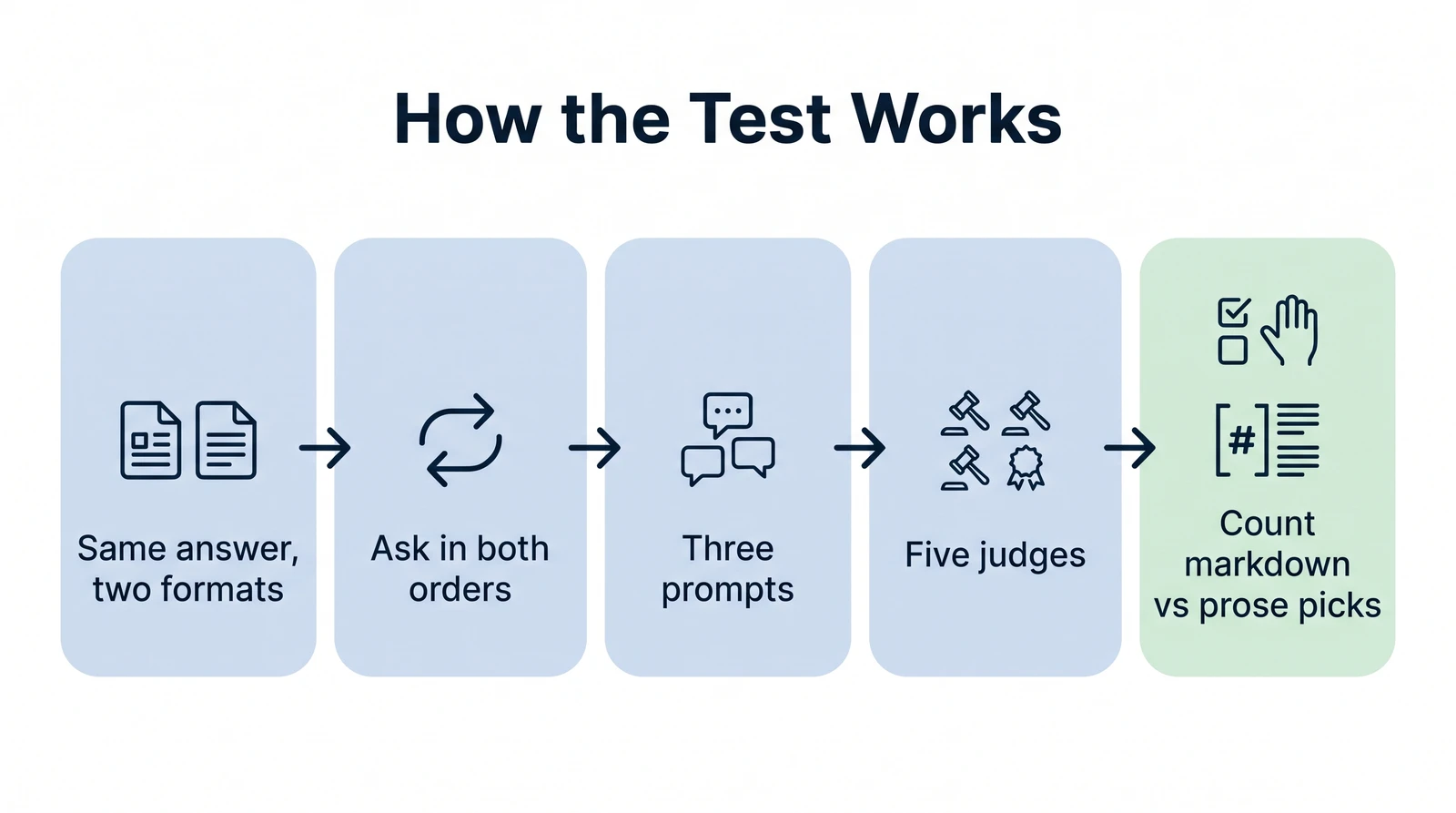
We kept everything else as the paper set it:
- The same 50 pairs, downloaded from the paper's repository at a fixed commit.
- The same three prompts, copied word for word:
- The plain prompt asks which response is better, with no other guidance.
- The rubric prompt asks for a score from 1 to 5 on accuracy, relevance, completeness, clarity and reasoning, and says "Do NOT consider response length or formatting style".
- The step-by-step prompt makes the judge write out five steps before its verdict: list what the question needs, assess Response A, assess Response B, compare the two "on substance (ignore length and formatting)", then decide.
- Both answer orders. Each pair is asked twice, once with markdown first and once with prose first, so order cannot explain the result.
- Temperature 0.1, the paper's setting. Each judge otherwise ran with its default settings.
That is 50 pairs × 2 orders × 3 prompts × 5 judges = 1,500 calls. The planted-error test in Result 3 added 300 calls, so the first run made 1,800 calls and cost $1.02. We then ran two of Gemini's planted-error tests twice more, for a total of 1,880 calls and $1.09.
The script, the planted errors and the raw output of every call are in the llm-judge-markdown-bias folder on GitHub.
How to read the scores#
- Markdown answer: the answer with headings, bullet lists and bold text.
- Prose answer: the same content written as plain paragraphs, with no formatting.
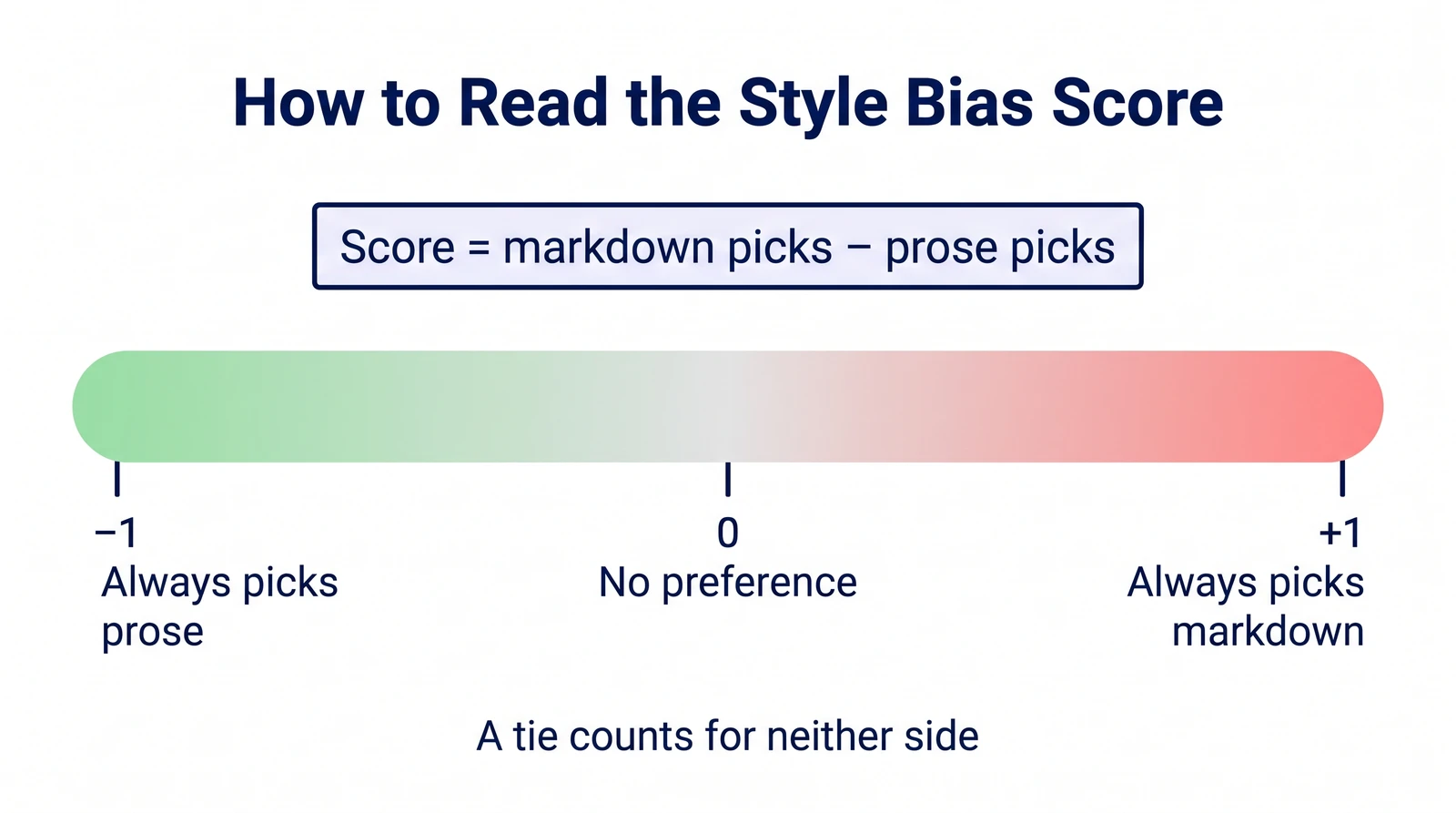
- Style bias score: the share of verdicts that pick markdown minus the share that pick prose.
- +1 means the judge always picks markdown, 0 means no preference, and −1 means it always picks prose.
- A tie counts for neither side, so many ties pull the score toward 0.
- Verdicts: each pair is asked twice, once in each order, so 24 pairs give 48 verdicts per judge and prompt.
- Example: on the 24 clean pairs from Result 2, with the plain prompt, Claude Haiku 5.5 picked markdown in 28 of 48 verdicts (58%), prose in 14 (29%) and a tie in 6 (12%). Its score is 0.58 − 0.29 = +0.29.
- 95% interval: the range of the score when we resample the pairs 2,000 times. When the interval includes zero, the bias could be chance.
Result 1: every judge prefers markdown#
The paper's test, run by us on five 2026 judges.
With the paper's plain prompt, all five judges picked the markdown answer much more often than the prose answer:
| Judge | Style bias, all 50 pairs | 95% interval |
|---|---|---|
| Gemini 3.5 Flash-Lite | +0.66 | +0.46 to +0.83 |
| DeepSeek V4.1 Flash | +0.56 | +0.36 to +0.75 |
| Claude Haiku 5.5 | +0.46 | +0.23 to +0.67 |
| Qwen3.8 Flash | +0.44 | +0.20 to +0.66 |
| GPT-6 Luna | +0.40 | +0.14 to +0.64 |
Every interval stays above zero, so for all five judges the bias is unlikely to be chance.
The two Gemini models land close together: the paper measured +0.72 for Gemini 2.5 Flash, and we measured +0.66 for Gemini 3.5 Flash-Lite. The other vendors moved more. GPT-4o scored +0.10 in the paper, while GPT-6 Luna scored +0.40 here. These are different models, so the numbers cannot tell us whether a vendor got worse. They do tell us that one model's low score predicts nothing about the next model's score.
Result 2: some of the paper's pairs are not fair#
Our addition. The paper does not report this.
Before running the test, we read the 50 pairs. In a fair pair, both answers say the same thing. Some pairs do not meet that rule.
In 26 of the 50 pairs, at least one answer stops in the middle of a sentence. These 26 include 14 pairs where the prose answer is less than 75% as long as the markdown answer, and 9% as long in the worst case. Two examples, linked to the exact line in the paper's data:
- Dice,
style_002. The markdown answer works through two methods and ends with the result 11/36. The prose answer has 62 words and stops at "the outcome of one die does not affect the outcome". - Vaccines,
style_034. The markdown answer has 550 words and lists the vaccine types. The prose answer has 68 words and stops at "the immune system takes time to identify it, learn".
In a pair like that, the markdown answer is better, so picking it is correct. The test still scores that verdict as style bias, because it assumes both answers hold the same content.
The flaw does not always favour markdown. In the database-index pair, style_016, the two answers are almost the same length, but the markdown one is the answer that stops mid-sentence.
To see how much the broken pairs change the score, we split the 50 pairs into three groups and scored each group with the plain prompt:
| Judge | 24 clean pairs | 12 pairs cut off mid-sentence, similar length | 14 pairs where prose is much shorter |
|---|---|---|---|
| Gemini 3.5 Flash-Lite | +0.44 | +0.71 | +1.00 |
| DeepSeek V4.1 Flash | +0.42 | +0.33 | +1.00 |
| Claude Haiku 5.5 | +0.29 | +0.17 | +1.00 |
| Qwen3.8 Flash | +0.25 | +0.17 | +1.00 |
| GPT-6 Luna | +0.25 | +0.00 | +1.00 |
| All five | +0.33 | +0.28 | +1.00 |
On the 14 pairs where the prose answer is much shorter, every judge picked markdown every time. Those verdicts measure completeness: the judges picked the complete answer, which is the right call. A cut-off last sentence matters much less: those 12 pairs score close to the clean ones. So the 14 short-prose pairs explain almost all of the gap between the 50-pair score and the clean score.
So for the rest of this article we use the 24 "clean" pairs, where both answers end on a complete sentence and neither is shorter than 75% of the other:
| Judge | All 50 pairs | 24 clean pairs | 95% interval, clean pairs |
|---|---|---|---|
| Gemini 3.5 Flash-Lite | +0.66 | +0.44 | +0.12 to +0.73 |
| DeepSeek V4.1 Flash | +0.56 | +0.42 | +0.10 to +0.71 |
| Claude Haiku 5.5 | +0.46 | +0.29 | −0.04 to +0.62 |
| Qwen3.8 Flash | +0.44 | +0.25 | −0.12 to +0.60 |
| GPT-6 Luna | +0.40 | +0.25 | −0.12 to +0.58 |
On the clean pairs, the average score drops from +0.50 to +0.33, about one third lower. With only 24 pairs, the intervals are wide. For three of the five judges, the interval includes zero, so this test cannot rule out a small or absent bias for them.
Judges do prefer markdown, as the paper says, but by less than the 50-pair score suggests. The clean-pair list is in the script, so anyone can check our filter.
Result 3: one judge chose a wrong answer for its formatting#
Our addition. The paper does not run this test.
A preference between two equal answers is a mild problem. A worse one in an eval pipeline is a judge that prefers a well-formatted wrong answer to a plainly written correct one. The paper does not test this, so we built a small test for it.
We took 10 of the clean pairs that contain a fact we could check. In each pair, we changed one fact in the markdown answer. We did not touch the prose answer, so it stayed correct. A fair judge should now pick the prose answer every time. Four of the ten changes:
| Question | The prose answer says (correct) | We changed the markdown answer to (wrong) |
|---|---|---|
| A store gives 20% off, then 15% off the new price. What is the total discount? | 32%, at any price. For example, on $100, 20% off gives $80, and 15% off $80 gives $68. | 35%. This adds 20% and 15%, the mistake the answer warns against. |
| What is the difference between permutations and combinations? The example uses three books. | The answer lists the 6 possible orders and says there are 6. | It still lists the 6 orders, then says there are 9. |
| When was general relativity published? (part of a longer answer) | 1915 | 1935 |
| How does the immune system fight infections? | The stomach is highly acidic. | The stomach is highly alkaline. |
The full list of ten changes is in the experiment's repository.
Each changed pair was asked in both orders with all three prompts:
| Judge | Picked the wrong markdown answer (plain prompt) | Rubric prompt | Step-by-step prompt |
|---|---|---|---|
| Claude Haiku 5.5 | 0 of 20 | 0 of 20 | 0 of 20 |
| GPT-6 Luna | 0 of 20 | 0 of 20 | 0 of 20 |
| DeepSeek V4.1 Flash | 0 of 20 | 0 of 20 | 0 of 20 |
| Qwen3.8 Flash | 0 of 20 | 0 of 20 | 0 of 20 |
| Gemini 3.5 Flash-Lite | 6 of 20 | 1 of 20, plus 3 ties | 0 of 20 |
We ran Gemini's planted-error test with the plain prompt and the step-by-step prompt two more times to check that this was not noise. With the plain prompt, it picked the wrong answer 6 of 20 times in all three runs, on the same four pairs. With the step-by-step prompt, the counts were 0, 2 and 1 out of 20, all on the stomach-acid pair.
In five of those six cases, Gemini's written explanation named the error and then picked the wrong answer anyway. From the stomach-acid pair:
"Response B contains one minor factual slip in the bullet points regarding stomach acid (calling it 'highly alkaline' instead of acidic), but because the underlying text is identical, Response B wins purely on formatting and readability."
The judge treated the error as a small detail, because the rest of the two texts matched. Teams use a pairwise judge to compare two prompt versions, and those versions often produce answers that are almost the same text, which is exactly the case where this judge let formatting decide.
Result 4: telling the judge to ignore formatting mostly creates ties#
The paper's prompts, run by us on five 2026 judges.
The paper's rubric prompt and step-by-step prompt both tell the judge to ignore formatting. The rubric prompt says it in capital letters, and the step-by-step prompt says it in step 4. On the 24 clean pairs, the style bias score changed like this:
| Judge | Plain prompt | Rubric prompt | Step-by-step prompt |
|---|---|---|---|
| Claude Haiku 5.5 | +0.29 | +0.10 | +0.12 |
| GPT-6 Luna | +0.25 | +0.27 | +0.08 |
| DeepSeek V4.1 Flash | +0.42 | +0.08 | +0.04 |
| Qwen3.8 Flash | +0.25 | +0.33 | +0.08 |
| Gemini 3.5 Flash-Lite | +0.44 | +0.25 | +0.33 |
The step-by-step prompt lowered the score for all five judges. For the four reasoning judges, the score fell to between +0.04 and +0.12, close to no preference. Gemini 3.5 Flash-Lite changed least and stayed at +0.33.
The rubric prompt lowered the score for three judges. It raised the score slightly for GPT-6 Luna and more for Qwen3.8 Flash. The reason is the way the score works. The rubric prompt turned most verdicts into ties, between 67% and 92% depending on the judge. But it removed the prose picks faster than the markdown picks. Qwen3.8 Flash is the clearest case:
| Qwen3.8 Flash, 48 verdicts | Picked markdown | Picked prose | Tie | Score |
|---|---|---|---|---|
| Plain prompt | 29 (60%) | 17 (35%) | 2 (4%) | +0.25 |
| Rubric prompt | 16 (33%) | 0 (0%) | 32 (67%) | +0.33 |
With the plain prompt, Qwen picked prose 17 times. With the rubric prompt, it never picked prose: every verdict that was not a tie went to markdown, so the score went up even though the judge chose a side less often.
The paper saw the same effect: with its rubric prompt, GPT-4o's score rose from +0.10 to +0.41.
Result 5: answer order barely matters#
The paper's test, run by us on five 2026 judges.
Each pair ran twice: once with the markdown answer shown first and once with the prose answer shown first. Nothing else changed between the two calls. We measured position bias as the share of verdicts for the first answer minus the share for the second answer. On the style pairs, the result stayed between −0.08 and +0.14 for every judge and prompt, and 11 of the 15 results were within ±0.06. This matches the paper. Order is a small bias for these judges, and asking each pair in both orders cancels what remains of it.
LLM-as-a-judge best practices from this test#
Style bias causes the most damage when you use an LLM as a judge to compare two versions of a prompt. If version B adds "Use headings and bullet points" to the system prompt, its answers will win more comparisons even when they are no more correct. The eval will report an improvement that only changed the formatting.
- Use a judge that reasons before answering for correctness checks. In our test, the four reasoning judges never chose the planted wrong answer. The non-reasoning judge did, on 30% of attempts with the plain prompt.
- Make the judge analyse each answer before it decides. The paper's step-by-step prompt does this. Compared with the plain prompt, it lowered the markdown lean for all five judges and cut Gemini's wrong picks from 6 of 20 to between 0 and 2.
- Remove formatting before judging when format is not part of the task. The paper recommends this. We did not test it, so we cannot report numbers for it.
- Count ties separately. A judge that returns 90% ties has stopped deciding. Your bias score can look small only because the judge rarely picks a side.
- Test your own judge on clean pairs. The script can run only the 24 clean pairs and the 10 planted errors for one judge. That is 204 calls, which cost between $0.04 (GPT-6 Luna, measured) and about $0.20 per judge with these models.
Limits of this test#
The clean set has 24 pairs, so the intervals are wide, and three judges' intervals include zero. Each combination of judge, prompt and test ran once at temperature 0.1, except the two Gemini tests we repeated. We also ran GPT-6 Luna a second time on the clean pairs, in a separate 204-call run not counted above. It scored +0.38 with the plain prompt, against +0.25 in the first run, so a single run's score can move by about 0.13. For the paper, Gemini 2.5 Flash wrote each prose answer by rewriting the markdown answer. The two versions are close but not word-for-word copies. Our 10 planted errors are changes to one fact. Real errors can be harder to spot, so the four reasoning judges' perfect score applies to this test only. One DeepSeek call in the first run hit the 6,000-token output limit before giving a verdict, and we counted it as invalid.
Run it yourself#
The code and data are in the llm-judge-markdown-bias folder of the article-experiments repository. The script needs only an OpenRouter key and httpx. It downloads the paper's pairs, runs the grid and writes every reply to a JSON Lines file. A second script turns that file into the tables in this article.
pip install httpx
export OPENROUTER_API_KEY=...
python run_judges.py      # 1,800 calls, about $1 with these five judges
python analyze.py         # prints the tables

# one judge, clean pairs and planted errors only (204 calls)
python run_judges.py --judge openai/gpt-6-luna --clean-only
The open question this leaves is about judges that do reason. They caught every planted error here, but they also leaned toward markdown on equal answers. A useful next test would plant smaller errors, such as a wrong step in the middle of a derivation, and find the point at which formatting starts to win again.
Written by Talha Anwar, senior ai / full-stack engineer. me@talhaanwar.com