· 28 min read
Are LLMs Deterministic? Five LLM Judges Changed Their Verdict on Identical Input
On this page
- At a glance
- What comes from the paper and what we added
- What the paper found
- What we found in the paper's code
- Our test: five cheap judges from 2026
- How to read the flip rate
- Result 1: every judge flips, on a few close pairs
- Result 2: temperature 0 does not make an LLM deterministic
- Result 3: answer order changes the winner more than re-running does
- Result 4: prompt wording, against a re-run baseline
- Result 5: the judges often disagree with each other
- What to do when your LLM judge is not deterministic
- Limits of this test
- Run it yourself
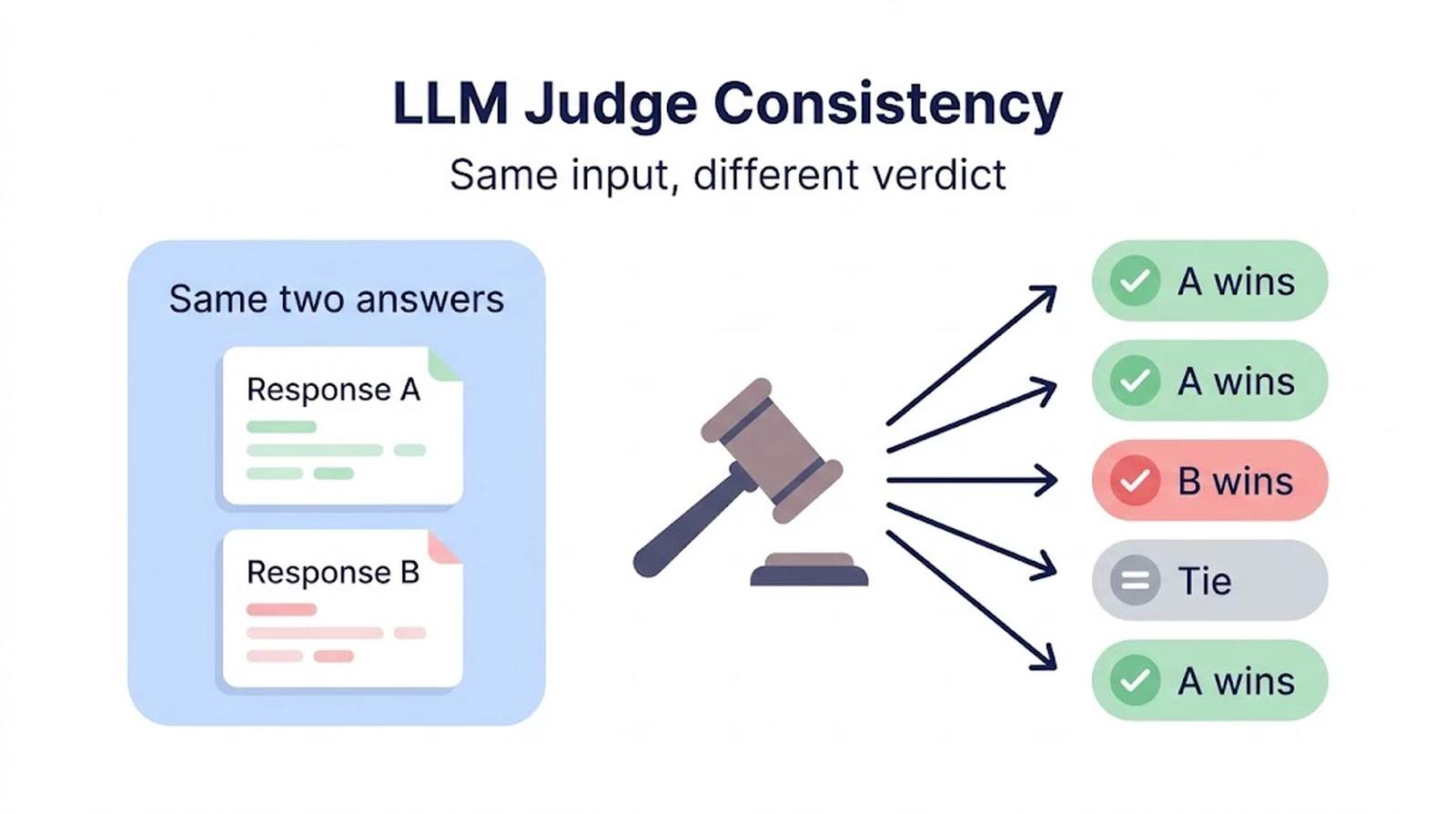
We gave GPT-6 Luna two answers to "List exactly 5 benefits of exercise" and asked which was better. We sent the same request ten times at temperature 0. Luna picked the first answer seven times and the second answer three times. In one of the three, it wrote: "Response B is slightly better because it offers a distinct benefit—greater energy and stamina—while avoiding the less precise claim that exercise increases metabolism." In the other runs, it said the first answer was more specific or covered more benefits. At temperature 1.0 the split reversed: seven votes for the second answer and three for the first.
So are LLMs deterministic? No, not even at temperature 0. The same model can give a different answer to the same input, and that matters most when the model is grading other models. This is part 2 of a series on LLM as a judge. A 2026 paper counted how often two OpenAI judges changed their verdict, and asked for someone to repeat the test on other vendors' models. We ran the paper's test on five low-cost judges from five vendors, with 7,250 calls that cost $3.11.
The short version
- All five judges change their verdict on identical input. Their flip rates are 5.5% to 14.8%, close to the paper's 13.6%.
- Most pairs never flip. The flips gather on a few close pairs, and for three of the five judges most flips are a move to or from a tie.
- Temperature 0 does not fix it. Every judge still flipped on 8 to 11 of the 29 pairs.
- Answer order matters more than re-running. For DeepSeek V4.1 Flash, swapping the two answers changed the winner on 13 of 29 pairs.
- The paper's position-bias result cannot be checked from its own runs, because it never swapped the answers.
At a glance#
| Question | What we measured |
|---|---|
| Do judges from other vendors flip too? | Yes. The flip rate is 5.5% for Gemini 3.5 Flash-Lite and 10.7% to 14.8% for the four judges that reason before answering. The paper measured 13.3% and 13.9%. |
| Where do the flips happen? | On a few pairs. Between 16 and 22 of the 29 pairs never flipped for each judge, and 2 to 8 pairs flipped on 3 or more of the 10 calls. |
| Does temperature 0 stop the flips? | No. The flip rate fell for three judges, barely moved for GPT-6 Luna, and rose for Gemini 3.5 Flash-Lite, from 5.5% to 9.0%. |
| Does answer order change the winner? | For three judges, yes. Swapping the answers changed the majority winner on 13 pairs for DeepSeek, 10 for Gemini and 7 for GPT-6 Luna. |
| Does prompt wording change the winner? | For GPT-6 Luna and Gemini, more than re-running does. For Claude Haiku 5.5 it changed one or two more winners than a re-run, and for Qwen and DeepSeek it changed fewer. |
| Do the five judges agree with each other? | All five gave the same majority winner on 15 of the 29 pairs. |
What comes from the paper and what we added#
| Part of this article | From the paper | Added by us |
|---|---|---|
| The 29 answer pairs and the two judge prompts | Yes | |
| The flip rate and the "A wins" index | Yes | |
| Results on GPT-4o-mini and GPT-4.1-mini | Yes | |
| Result 1: flip rate on five judges from five vendors | The method | The run and the numbers |
| Result 2: temperature 0 | The method | The run and the numbers |
| Result 3: the same pairs with the answers swapped | Yes | |
| Result 4: prompt wording, with a re-run baseline | The method | The baseline and the fixed prompt |
| Result 5: agreement between judges | The method | The run and the numbers |
What the paper found#
The paper is The Coin Flip Judge: Reliability and Bias in LLM-as-a-Judge Evaluation by Abel Yagubyan, published in 2026. It asks a narrow question: if you send the same judge the same two answers many times, how often does the verdict change?
The author wrote 29 questions in 10 categories, such as coding, writing, math and extraction. For each question, GPT-4o-mini wrote one answer and GPT-4o wrote the other, so the two answers are close in quality. Two judges, GPT-4o-mini and GPT-4.1-mini, compared each pair 50 times at temperature 1.0.
The main results:
- 13.6% flip rate. On average, 13.6% of the verdicts disagreed with the majority verdict for that pair. This is the mean of the two judges, 13.3% for GPT-4o-mini and 13.9% for GPT-4.1-mini. The worst pair reached 56%.
- 72% "A wins". The paper's "A wins" index is the share of pairs whose majority verdict is Response A, the answer shown first. For GPT-4o-mini it was 72%, or 21 of 29 pairs. The paper reads this as a preference for the first position.
- Temperature 0 helps but does not fix it. The flip rate fell to 2.8% for GPT-4o-mini and to 7.9% for GPT-4.1-mini.
- 25% prompt sensitivity. A second prompt with the same meaning, which the paper calls prompt B, changed the majority verdict in 5 of 20 cases.
- 11 calls for a stable verdict. A majority of 11 calls matched the 50-call majority 95% of the time.
The author published the code, the 29 pairs and the raw results on GitHub under the MIT licence.
What we found in the paper's code#
We read the code before running anything. Three details in it change how some of the paper's results read.
- The answers were never swapped. GPT-4o-mini's answer is always Response A, shown first, and GPT-4o's answer is always Response B, shown second. The 72% "A wins" result could mean the judge prefers whatever comes first, or it could mean the judge prefers GPT-4o-mini's answers. The paper's limits section names this problem, and its runs cannot separate the two. We test it in Result 3.
- Prompt B has mismatched labels. It shows the answers as "Answer 1" and "Answer 2", then asks for the verdict as
[[A]]or[[B]]. A judge could give no readable verdict, or mean the wrong answer. We test it in Result 4. - Replies with no verdict are dropped. In the paper's own raw results for prompt B, GPT-4.1-mini gave no readable verdict in 46 of 200 calls. With the first prompt, it gave a readable verdict every time. The flip rate counts only the replies that had one.
Our test: five cheap judges from 2026#
We used the same five judges as part 1 of this series, one recent low-cost model from each vendor:
| Judge | Price per 1M tokens (in / out) | Reasons before answering? |
|---|---|---|
| Claude Haiku 5.5 | $0.10 / $0.50 | Yes, 295 reasoning tokens per call on average |
| GPT-6 Luna | $0.10 / $0.50 | Yes, 163 |
| DeepSeek V4.1 Flash | $0.045 / $0.50 | Yes, 990 |
| Qwen3.8 Flash | $0.15 / $0.47 | Yes, 627 |
| Gemini 3.5 Flash-Lite | $0.30 / $2.50 | No, 0 |
We kept the paper's pairs and prompts and ran four experiments. Each experiment asked every judge about every pair 10 times in each answer order it uses.
The test in numbers
29 pairs × 5 judges × 10 calls = 1,450 calls per setting.
We ran five settings: the paper's answer order, the swapped order, temperature 0, prompt B and the fixed prompt B. That makes 7,250 calls in total. Every table below compares the 10 calls of one judge on one pair in one setting.
| Experiment | Prompt | Temperature | Answer order | Calls |
|---|---|---|---|---|
| Repeat | The paper's main prompt | 1.0 | The paper's order, then swapped | 2,900 |
| Temperature 0 | The paper's main prompt | 0 | The paper's order | 1,450 |
| Prompt B | The paper's second prompt, unchanged | 1.0 | The paper's order | 1,450 |
| Prompt B, fixed | The second prompt with the labels changed to "Answer A" and "Answer B" | 1.0 | The paper's order | 1,450 |
That is 7,250 calls. Qwen3.8 Flash returned 419 rate-limit errors along the way, and the script retried each one until it got a reply. The run cost $3.11 through OpenRouter on 31 October 2026.
The paper ran 50 calls per pair and we ran 10. With 10 calls, the flip rate of one pair moves in steps of 10 percentage points, so single-pair numbers are rough. The averages over 29 pairs are steadier.
We also checked our analysis against the paper. Our flip-rate code, run on the paper's raw results, gives 13.3% for GPT-4o-mini and 13.9% for GPT-4.1-mini, the same numbers the paper reports.
The script, the analysis and the raw output of every call are in the llm-judge-flip-rate folder on GitHub.
How to read the flip rate#
Example: one pair, ten calls#
Each of the 29 test items is a question with two answers. This is pair q023, the exercise question from the top of the article. GPT-4o-mini wrote Response A and GPT-4o wrote Response B.
Question: "List exactly 5 benefits of exercise. Number them 1-5. Each benefit should be one sentence only."
| # | Response A (GPT-4o-mini) | Response B (GPT-4o) |
|---|---|---|
| 1 | Exercise improves cardiovascular health by strengthening the heart and enhancing blood circulation. | Exercise improves cardiovascular health by strengthening the heart and increasing circulation. |
| 2 | Regular physical activity helps to maintain a healthy weight by burning calories and increasing metabolism. | Regular physical activity boosts mental health by reducing symptoms of anxiety and depression. |
| 3 | Exercise boosts mental health by reducing symptoms of anxiety and depression through the release of endorphins. | Engaging in exercise helps with weight management by burning calories and building muscle mass. |
| 4 | Engaging in physical activity enhances muscle strength and flexibility, promoting overall body functionality. | Exercise enhances sleep quality, leading to more restful and restorative sleep cycles. |
| 5 | Regular exercise improves sleep quality, helping individuals fall asleep faster and enjoy deeper rest. | Consistent physical activity increases energy levels by improving overall stamina and reducing fatigue. |
The judge gets the question, both answers and the paper's instructions. The instructions end with three allowed verdicts, not two:
[[A]] if Response A is better
[[B]] if Response B is better
[[tie]] if they are equally good
A tie is the judge saying the two answers are equally good. This is the end of one real reply from Qwen3.8 Flash on this pair:
Both responses follow the instructions exactly: each provides five numbered benefits, each written as one sentence. They are similarly accurate, relevant, clear, and sufficiently helpful.
[[tie]]
We sent this exact input to each judge 10 times, at temperature 1.0 and in the order shown above:
| Judge | The 10 verdicts | Majority verdict | Flip rate on this pair |
|---|---|---|---|
| Claude Haiku 5.5 | A ×10 | A | 0% |
| Gemini 3.5 Flash-Lite | A ×10 | A | 0% |
| GPT-6 Luna | B ×7, A ×3 | B | 30% |
| DeepSeek V4.1 Flash | tie ×7, A ×3 | tie | 30% |
| Qwen3.8 Flash | tie ×5, A ×3, B ×2 | tie | 50% |
Claude Haiku 5.5 and Gemini 3.5 Flash-Lite gave the same verdict every time. Qwen3.8 Flash called the pair a tie 5 times, so its majority verdict is a tie. Its other 5 verdicts differ from that majority, so its flip rate on this pair is 50%.
The terms in the tables#
- Cell: one judge, one pair, one setting, asked 10 times.
- Majority verdict: the verdict the judge gave most often in that cell. It can be Response A, Response B or a tie.
- Flip rate of a cell: the share of the 10 verdicts that differ from the majority. If the judge says A seven times and B three times, the flip rate is 30%.
- 0% means the judge gave the same verdict every time, so a lower flip rate is better. A 5-5 split between the two answers gives 50%, the highest any cell reached in our run.
- A tie counts as a verdict. A judge that says A eight times and "tie" twice has a flip rate of 20%.
- A judge's flip rate is the average over its 29 cells.
- First answer and second answer: the answer shown as Response A and the answer shown as Response B. Swapping the order moves each model's answer to the other position.
Result 1: every judge flips, on a few close pairs#
The paper's test, run by us on five judges from five vendors.
We used the paper's prompt, the paper's answer order and temperature 1.0, and asked each judge about each pair 10 times.
How to read this table
- Flip rate: how many of the judge's verdicts differ from its usual verdict for that pair, as defined above. Lower is better.
- Where 290 comes from: each judge got 29 pairs × 10 calls = 290 verdicts. A few replies had no readable verdict and were dropped, so three judges have 288 or 289.
- Pairs that never flipped: pairs where all 10 verdicts were the same. Higher is better.
- Pairs with 3+ flips out of 10: pairs where at least 3 of the 10 verdicts differed from the usual one. Lower is better.
| Judge | Flip rate | Pairs that never flipped | Pairs with 3+ flips out of 10 |
|---|---|---|---|
| Qwen3.8 Flash | 43 of 289 (14.8%) | 16 of 29 | 8 of 29 |
| DeepSeek V4.1 Flash | 35 of 288 (12.2%) | 17 of 29 | 8 of 29 |
| Claude Haiku 5.5 | 32 of 290 (11.0%) | 19 of 29 | 6 of 29 |
| GPT-6 Luna | 31 of 289 (10.7%) | 17 of 29 | 6 of 29 |
| Gemini 3.5 Flash-Lite | 16 of 290 (5.5%) | 22 of 29 | 2 of 29 |
What this means for an eval: with one call per pair, about 1 Qwen3.8 Flash verdict in 7 differs from Qwen's usual answer. For Gemini 3.5 Flash-Lite, it is about 1 in 18.
The four reasoning judges flip on 10.7% to 14.8% of calls, close to the paper's 13.3% and 13.9% for OpenAI's judges.
Most pairs never flip. The flips come from a few pairs where the two answers are close. Every judge had at least one pair where its usual verdict won only 5 of the 10 calls.
Gemini, the only judge that does not reason, flipped least, and it repeats its mistakes too. In part 1, we planted a factual error in 20 answers, and Gemini picked the same 6 wrong answers in all three runs.
Mild flips and full reversals#
A flip from "A" to "tie" matters less than a flip from "A" to "B". We split every verdict that disagreed with its majority:
How to read this table
- Each row is one judge on all 29 pairs, 10 calls each.
- Verdicts that disagreed with the majority are the flips from Result 1, for example 43 of Qwen's 289 verdicts.
- Tie against a winner is a mild flip. The majority picked A or B and this call said tie, or the majority was tie and this call picked A or B.
- Winner against the other winner is a full reversal. The majority said A and this call said B, or the other way round. A high number here is the worse result.
- Disagreed with the majority = Tie against a winner + Winner against the other winner. For Qwen, 43 = 18 + 25.
| Judge | Verdicts that disagreed with the majority | Tie against a winner | Winner against the other winner |
|---|---|---|---|
| Qwen3.8 Flash | 43 | 18 | 25 |
| DeepSeek V4.1 Flash | 35 | 23 | 12 |
| Claude Haiku 5.5 | 32 | 26 | 6 |
| GPT-6 Luna | 31 | 8 | 23 |
| Gemini 3.5 Flash-Lite | 16 | 9 | 7 |
What this means for an eval: Claude Haiku 5.5 rarely reversed a verdict, and 26 of its 32 flips moved to or from a tie. A flip like that turns a win into a tie, which moves a win count only a little. DeepSeek V4.1 Flash and Gemini 3.5 Flash-Lite also flipped to or from a tie more often than not. GPT-6 Luna and Qwen3.8 Flash are the opposite. In most of their flips the other answer won, so one flip takes a win from one side and gives it to the other.
Result 2: temperature 0 does not make an LLM deterministic#
The paper's test, run by us on five judges from five vendors.
How to read this table
- Lower is better in all four columns.
- Pairs that flipped at least once: pairs where the 10 identical calls did not all give the same verdict. At temperature 1.0, this is 29 minus the "Pairs that never flipped" column in Result 1.
- If temperature 0 made a judge fully repeatable, its temperature 0 flip rate would be 0% and its last column would read 0 of 29.
| Judge | Flip rate, temperature 1.0 | Flip rate, temperature 0 | Pairs that flipped at least once, temperature 1.0 | Pairs that flipped at least once, temperature 0 |
|---|---|---|---|---|
| Qwen3.8 Flash | 14.8% | 8.6% | 13 of 29 | 10 of 29 |
| DeepSeek V4.1 Flash | 12.2% | 7.2% | 12 of 29 | 8 of 29 |
| Claude Haiku 5.5 | 11.0% | 9.3% | 10 of 29 | 10 of 29 |
| GPT-6 Luna | 10.7% | 10.3% | 12 of 29 | 11 of 29 |
| Gemini 3.5 Flash-Lite | 5.5% | 9.0% | 7 of 29 | 11 of 29 |
What this means for an eval: every judge still gave different verdicts on 8 to 11 of the 29 pairs, about a third, when it saw exactly the same input at temperature 0. At temperature 1.0, the count was 7 to 13.
The paper's GPT-4o-mini fell to 2.8% at temperature 0. Our five judges stayed between 7.2% and 10.3%.
Temperature 0 cut the flip rate by about 40% for DeepSeek and Qwen. It hardly changed Claude Haiku 5.5 or GPT-6 Luna, and Gemini flipped more often at temperature 0 than at 1.0. Our script sent temperature 0 with every request. A provider may still sample a model's hidden reasoning at its own setting, and we cannot see that from outside.
The exercise question at the top of this article is one of these pairs. At temperature 1.0, GPT-6 Luna gave the second answer 7 of 10 votes. At temperature 0, it gave the first answer 7 of 10 votes.
Why are LLMs non-deterministic at temperature 0?#
Temperature 0 tells the model to pick the most likely next token every time. It does not make the numbers behind that choice the same on every call. Thinking Machines Lab traced the main cause in 2025: an inference server groups many users' requests into one batch, and the batch size changes the order of floating-point additions. A slightly different sum can change which token is most likely. Once one token differs, the rest of the reply differs too. A judge writes hundreds of tokens of explanation before its verdict, so a first difference has many places to appear. Our test shows that the verdicts changed, but it cannot show the cause for each judge.
Result 3: answer order changes the winner more than re-running does#
Our addition. The paper's published runs never swap the answers.
We swapped the places of the two answers and sent every pair to the judge again. In the paper's order, GPT-4o-mini's answer comes first. In the swapped order, GPT-4o's answer comes first.
A judge can pick a different winner even when nothing changes, so we also measured this normal noise. We split the 10 calls in the paper's order into calls 1-5 and calls 6-10. Then we counted the pairs where the two halves picked a different winner.
What we expect from a fair judge
A fair judge picks the same answer in both orders. Above 50% in the first column means the judge leans toward the first slot, and below 50% means it leans toward the second slot.
How to read this table
- Picked the answer shown first: each pair ran 10 times in each order. Of the calls where the judge picked a winner, this is the share that went to the answer shown first. Ties are left out.
- Winner changed by noise: we sent the same prompt 10 times in the paper's order. We took the winner of calls 1-5 and the winner of calls 6-10. Nothing changed between those calls, so a different winner can only come from noise. This column counts the pairs where the two winners differed.
- Winner changed by swap: we took the winner in the paper's order and the winner in the swapped order. This column counts the pairs where the two winners differed. If this count is much higher than the noise count, the swap changed the winner.
| Judge | Picked the answer shown first | Winner changed by noise | Winner changed by swap |
|---|---|---|---|
| DeepSeek V4.1 Flash | 68.5% | 5 of 29 | 13 of 29 |
| Gemini 3.5 Flash-Lite | 63.7% | 2 of 29 | 10 of 29 |
| Claude Haiku 5.5 | 52.3% | 4 of 29 | 5 of 29 |
| Qwen3.8 Flash | 49.1% | 6 of 29 | 5 of 29 |
| GPT-6 Luna | 40.0% | 1 of 29 | 7 of 29 |
What this means for an eval: with DeepSeek V4.1 Flash as the judge, swapping the order changed the winner on 13 of 29 pairs, almost half. Noise alone changed 5. An eval that always shows one model's answer first gives that model an advantage with DeepSeek or Gemini as the judge, and a disadvantage with GPT-6 Luna.
DeepSeek V4.1 Flash and Gemini 3.5 Flash-Lite prefer whichever answer comes first. For DeepSeek, order changed the winner on 13 pairs, against 5 for plain re-running. GPT-6 Luna leans the other way and prefers the second answer. Claude Haiku 5.5 and Qwen3.8 Flash show no order effect beyond normal flipping.
In part 1, answer order hardly mattered. Part 1's pairs held the same content in two formats, and the judges preferred the markdown side in most of them. Here both answers are close in quality. One possible reason for the difference: when a judge has no clear preference, the position decides. This test does not prove that.
Result 3 also helps with the question about the paper's 72%. Three of our judges preferred GPT-4o-mini's answer even when both orders were counted: Claude Haiku 5.5 in 61.8% of the verdicts that named a winner, GPT-6 Luna in 58.1% and Qwen3.8 Flash in 57.4%. In the paper, GPT-4o-mini's answer was always shown first. So part of the paper's 72% may be a preference for GPT-4o-mini's answers, not for the first slot.
Result 4: prompt wording, against a re-run baseline#
The paper's test plus our baseline and fixed prompt.
The paper wrote two prompts with the same meaning: the main prompt and prompt B. It ran prompt B on only 10 of its 29 questions, with both of its judges. That gives 20 cases, where one case is one judge on one question. In 5 of the 20 cases, prompt B gave a different majority winner than the main prompt.
A winner can also change when the prompt stays the same, so we used the same noise baseline as in Result 3. Every column compares two majorities of 5 calls each, so the three columns can be compared.
How to read this table
- Each cell counts the pairs, out of 29, where two sets of 5 calls picked different winners. The winner of a set is the verdict that most of its 5 calls gave.
- Same prompt, two halves: calls 1-5 against calls 6-10 of the paper's main prompt. The prompt did not change, so a different winner can only come from noise. This column is the baseline.
- Paper's prompt vs prompt B: calls 1-5 of the main prompt against calls 1-5 of prompt B.
- Paper's prompt vs prompt B, fixed: calls 1-5 of the main prompt against calls 1-5 of prompt B with its labels changed to "Answer A" and "Answer B".
- If a prompt column is much higher than the baseline, the wording changed the winner. If it is about the same or lower, the difference is within normal noise.
| Judge | Same prompt, two halves | Paper's prompt vs prompt B | Paper's prompt vs prompt B, fixed |
|---|---|---|---|
| Gemini 3.5 Flash-Lite | 2 of 29 | 7 of 29 | 7 of 29 |
| GPT-6 Luna | 1 of 29 | 5 of 29 | 6 of 29 |
| Claude Haiku 5.5 | 4 of 29 | 6 of 29 | 5 of 29 |
| Qwen3.8 Flash | 6 of 29 | 4 of 29 | 5 of 29 |
| DeepSeek V4.1 Flash | 5 of 29 | 2 of 29 | 3 of 29 |
What this means for an eval: with Gemini 3.5 Flash-Lite and GPT-6 Luna, a small change to the judge prompt matters more than running the eval again. The new wording changed the winner on 17% to 24% of the pairs. Running the same prompt again changed the winner on only 3% to 7%. Claude Haiku 5.5 reacted a little more to the wording: 17% to 21% of the pairs, against 14% for a re-run. For Qwen3.8 Flash and DeepSeek V4.1 Flash, the new wording changed fewer winners than a plain re-run did.
The label mistake hurt the paper's judge but not ours. Prompt B calls the two answers "Answer 1" and "Answer 2", but then asks the judge to reply [[A]] or [[B]]. A judge can get confused and reply in a way the script cannot read, for example "Answer 1 is better".
- In the paper: GPT-4.1-mini gave an unreadable reply in 46 of 200 calls, about 23%.
- In our run: no judge gave more than 2 unreadable replies out of 290 calls, under 1%, with any of the prompts.
Fixing the labels did not change the results. Our fixed prompt B says "Answer A" and "Answer B". In the table, the two prompt B columns differ by at most 1 pair for each judge: 7 and 7, 5 and 6, 6 and 5, 4 and 5, 2 and 3. So the label mistake barely changed which answer won.
Result 5: the judges often disagree with each other#
The paper's test, run by us on five judges from five vendors.
We took each judge's majority winner over all 20 calls per pair, in both orders, and compared the judges.
How to read this table
Each cell is the number of pairs, out of 29, where the two judges picked the same winner. 29 would mean the two judges always agree. A higher number means the two judges decide more alike.
| Claude Haiku 5.5 | GPT-6 Luna | DeepSeek V4.1 Flash | Qwen3.8 Flash | Gemini 3.5 Flash-Lite | |
|---|---|---|---|---|---|
| Claude Haiku 5.5 | – | 21 | 21 | 21 | 18 |
| GPT-6 Luna | 21 | – | 26 | 27 | 19 |
| DeepSeek V4.1 Flash | 21 | 26 | – | 27 | 18 |
| Qwen3.8 Flash | 21 | 27 | 27 | – | 19 |
| Gemini 3.5 Flash-Lite | 18 | 19 | 18 | 19 | – |
What this means for an eval: the winner often depends on which judge you choose. All five judges agreed on 15 of the 29 pairs, so on the other 14 at least one judge picked a different winner. Switching from Gemini 3.5 Flash-Lite to Qwen3.8 Flash as the judge changes the winner on 10 of the 29 pairs. GPT-6 Luna, DeepSeek V4.1 Flash and Qwen3.8 Flash agreed with each other on 26 or 27 pairs. Gemini agreed with each of the others on only 18 or 19. The paper's two OpenAI judges agreed on 22 of 29.
What to do when your LLM judge is not deterministic#
The flips matter most when an eval compares two versions of a prompt or a model and the difference is small. Say version B beats version A by two points in one eval run. With a judge that flips 10% of its verdicts, the next run can erase that gain.
- Run every comparison in both orders. Count a pair as a win only when the same answer wins in both orders, and count it as a tie otherwise. The check catches the order effect from Result 3. It also gives each pair a second call, which catches some of the flips from Result 1.
- Do not rely on temperature 0. Four of our five judges flipped on 10 or 11 pairs at temperature 0.
- Spend extra calls only on close pairs. Most pairs never flipped. Ask once in each order, and send more calls only to the pairs where the two orders disagree.
- Report ties as their own number. For Claude Haiku 5.5 and DeepSeek V4.1 Flash, most flips moved to or from a tie. A win rate that leaves ties out hides those flips.
- Measure your judge's re-run baseline before you trust a prompt change. Run your current eval twice and count how many verdicts change. A new judge prompt has to beat that number before it counts as an improvement.
Limits of this test#
The test has 29 pairs and 10 calls per cell, so one changed verdict moves a judge's flip rate by about 0.3 percentage points. The categories hold 2 to 4 pairs each, so a gap between two categories may be chance. For what it shows, extraction (23.3%) and coding (16.7%) flipped most often across the five judges, and the paper also found coding among the least stable categories. Every pair compares GPT-4o-mini with GPT-4o, two close models from one vendor. Answers of clearly different quality would flip less. We ran each experiment once, through OpenRouter, on one day. 15 of the 7,250 replies had no readable verdict and are left out of the flip rates, as in the paper, so 11 cells have 9 verdicts and 2 cells have 8.
Run it yourself#
The code and data are in the llm-judge-flip-rate folder of the article-experiments repository. The script needs only an OpenRouter key and httpx. It downloads the paper's 29 pairs, runs the four experiments and writes every reply to a JSON Lines file. A second script turns that file into the tables in this article.
pip install httpx
export OPENROUTER_API_KEY=...
python run_judges.py      # 7,250 calls, about $3 with these five judges
python analyze.py         # prints the tables

# your own judge, the repeat experiment only (580 calls)
python run_judges.py --judge openai/gpt-6-luna --experiment repeat
Part 1 of this series, LLM-as-a-Judge Bias: Judges Reward How an Answer Looks, Not What It Says, tests whether the same five judges prefer markdown answers over plain prose with the same content.
Written by Talha Anwar, senior ai / full-stack engineer. me@talhaanwar.com