· 7 min read
How a Bootstrapped Startup Got $500 in Runware Credits, and What Four Other Programs Said
On this page
I run AcruxCore, an open-source LLM-ops platform. It has no funding, and every model call we make for tests, benchmarks and tutorials is paid from our own pocket. So I applied to startup programs that give model credits. I was not looking for a large grant. Even $1,000 covers months of the calls we make.
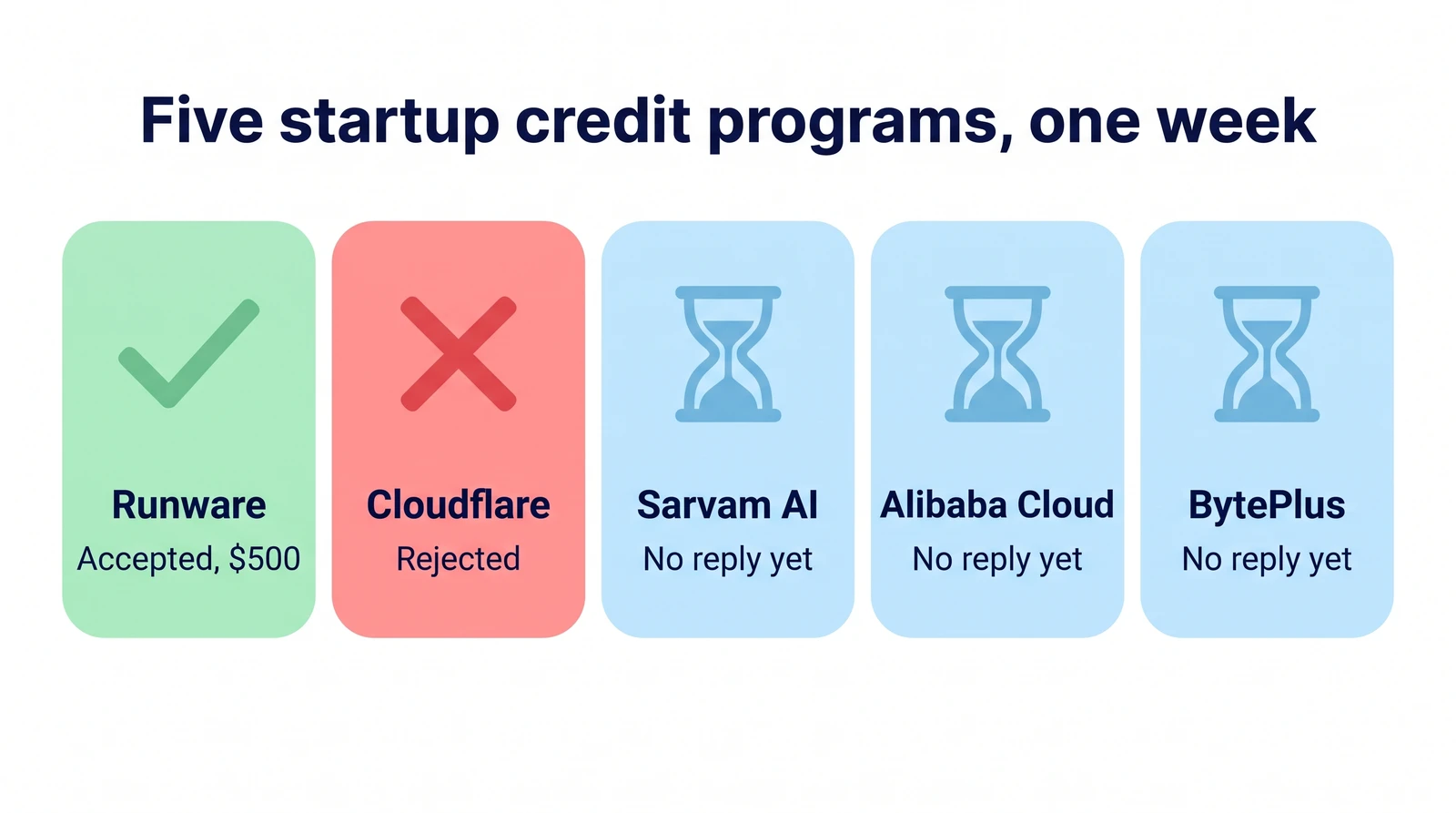
I applied to five programs in one week. The first answer came from Runware. AcruxCore was accepted into the Runware Startup Program with $500 in credits, and the credits are now in our account. The second answer came from Cloudflare, and it was no.
The short version
- Runware gave a bootstrapped project with no revenue $500 in credits.
- The form asks what you build, what traction you have, and how you will use Runware.
- Small real numbers were enough. We had about 1,600 SDK downloads in the last 30 days and 12 GitHub stars.
- A specific plan for the credits matters more than a large company.
- Cloudflare turned us down two days later because our website "appears to be in very early development". Reviewers look at the website before the numbers.
- The other three programs sent no email after I submitted, so I do not know yet if they received the applications.
What the application asked#
The Runware startup program form has one page. It asks for your name, company, website and job title. It asks how much funding you have raised, and "bootstrapped, $0" is one of the options. Then it asks three questions in your own words: what the company does, what traction it has, and how you plan to use Runware.
There is also a question about whether you have used Runware before. I had not, and I answered no. The form does not require you to be a customer already.
What we wrote#
For the company description, I wrote what AcruxCore does in two sentences: prompt management, an AI gateway, tracing and evaluation for teams that build with LLMs. I linked the docs and the public source code, so a reviewer could check every claim in a few minutes.
For traction, I used the numbers I could link to on 3 November 2026:
| Signal | Number |
|---|---|
| npm downloads of the TypeScript SDK, last 30 days | 854 |
| PyPI downloads of the Python SDK, last 30 days | 755 |
| GitHub stars | 12 |
These are small numbers, and I wrote them as they were. A reviewer can open npm, PyPI and GitHub and see the same figures. A larger number that does not match the public page does more harm than a small one that does.
For the plan, I wrote what I would actually build. AcruxCore's gateway sends text model calls to OpenAI, Anthropic, Gemini and any OpenAI-compatible endpoint. It has no image generation yet. The plan is to add image generation to the gateway with Runware as the first provider, then publish a benchmark and a tutorial that use it. I chose the Starter tier and estimated a few thousand image generations. That is a small request, and it matches the size of the project.
Why I think it was approved#
I can only guess, because the email gave no reasons. My guess is that the plan was concrete. It named a feature, a provider and two pieces of public writing that will exist when the credits are used. Runware gets an integration and content that mentions its API, and the cost to them is $500.
The second reason is probably that everything was checkable. The website, docs, source code and package pages were all public, so the reviewer did not have to trust anything I wrote.
What happens after approval#
The approval email lists three steps:
- Sign up at Runware and verify your email.
- Copy the Workspace ID from the workspace settings page.
- Reply to the email with your sign-up email and the Workspace ID.
Runware says it adds the credits within two working days of your reply. Our $500 is now in the workspace, and it works across every model on the platform.
The four other programs#
I sent the same company description and the same traction numbers to every program. Only the plan changed, because each plan named that program's own models or services.
| Program | Applied | Result so far |
|---|---|---|
| Runware Startup Program | 3 Nov | Accepted on 4 Nov, $500 in credits |
| Cloudflare for Startups | 3 Nov | Rejected on 5 Nov. I replied the same day and asked them to look again. No answer yet. |
| Sarvam AI Startup Program | 3 Nov | Submitted, no confirmation email |
| Alibaba Cloud AI Catalyst Program | 5 Nov | Submitted, no confirmation email |
| BytePlus Global Startups Accelerator (V-START) 2026 | 5 Nov | Submitted, no confirmation email |
Cloudflare for Startups: rejected#
Cloudflare gives credits for its own services, including Workers AI. A bootstrapped company with no funding can get up to $10,000, and up to $2,500 of that can go to Workers AI.
The rejection came two days after I applied. It said our website appears to be in very early development. That was the only reason it gave.
I replied in the same email thread. I wrote that AcruxCore is live at acruxcore.com, that the source code is public under the Apache 2.0 license, and that the SDKs are on npm and PyPI. I also listed four ways we would use Cloudflare. The first is to add Workers AI as a provider in the AcruxCore gateway. The other three are Workers to lower gateway latency, R2 to store traces, and Cloudflare's firewall and rate limiting in front of the API. Cloudflare has not answered yet. Its FAQ asks you to wait a week before you follow up, and it does not accept a second application, so writing in the same thread is the only option.
The lesson I take from this: Runware judged the plan, and Cloudflare judged the website. Our numbers were the same in both applications. If your landing page looks thin, a reviewer may decide the project is early before reading the rest.
Sarvam AI Startup Program: no reply yet#
Sarvam gives credits for its Indian-language models. Startups that are accepted must show "Powered by Sarvam" in their product. AcruxCore has no focus on India, so the fit is weak. The plan I wrote was to add Sarvam as a provider in the gateway.
Alibaba Cloud AI Catalyst Program: no reply yet#
The Alibaba program runs until 31 March 2027. The form asks for your Alibaba Cloud account ID and how much you spend each month. I chose the lowest option, below $1,000 a month. The plan was to add Alibaba's Qwen models to the gateway and to publish research reproductions that use them.
BytePlus V-START 2026: no reply yet#
BytePlus is ByteDance's cloud business, and V-START is its accelerator for startups. The program needs a founder who can attend in person, and the form does not say where or when. I submitted the form, and no confirmation email came.
Programs I did not apply to#
AWS Activate Founders gives $1,000 in credits. I kept it as a backup, because AcruxCore's gateway has no adapter for Amazon Bedrock yet. Google for Startups Cloud expects a funding plan, and we have none.
Confirmation emails#
Runware sent an email to confirm it had received the application. Cloudflare, Sarvam, Alibaba and BytePlus sent nothing after I submitted. Cloudflare's first email was its decision. If you apply to any of them, no email does not mean the form failed. Wait a week before you write to them, and do not apply again.
If you run a small project and spend your own money on model calls, apply. Pick the programs whose models you will actually use, and write a plan you can deliver.
Written by Talha Anwar, senior ai / full-stack engineer. me@talhaanwar.com